AGPCNP Preceptor Placement for Purdue Global MSN Students
If you are in the Adult-Gerontology Primary Care Nurse Practitioner track at Purdue Global, your coursework is online but your practicum is not. You need a real clinic, a qualified preceptor who practices adult and older-adult primary care, and a signed affiliation agreement between that site and the university before you can log a single hour. We are an independent service that sources the preceptor and moves the paperwork with you, so the placement does not become the thing that delays your degree. We are not Purdue University, Purdue Global, or the CCNE.
Last updated July 2026. Verified against the current Purdue Global nursing handbook.
Get matched, free
Tell us your track and city, we'll plan your placement. No payment until you're matched.
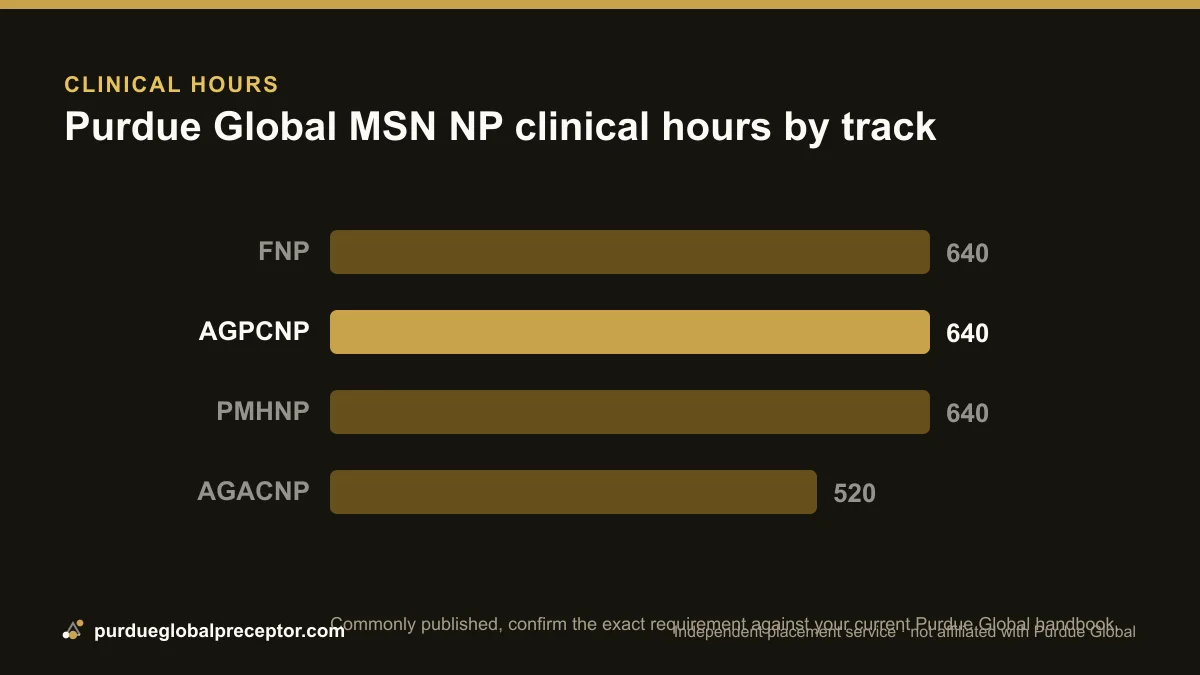
What the AGPCNP practicum actually requires
Purdue Global delivers the AGPCNP MSN coursework 100% online, but the clinical practicum is in person and local to you. You complete supervised hours in a real adult-primary-care setting under a preceptor who agrees to teach, observe, and sign off on your work. The number commonly published for this program is 640 clinical hours; we confirm the exact requirement against your current Purdue Global handbook, because the hours of record are the ones in your handbook and your program's clinical tracking system, not a figure on any website.
Two pieces have to line up before those hours count. First, the preceptor and site must meet your program's criteria for the specialty. Second, the clinic must hold a signed clinical affiliation agreement with Purdue Global. If either is missing, hours logged at that site may not be accepted, which is exactly the situation we help you avoid by checking both up front.
Under Purdue Global's clinical model, the student carries primary responsibility for locating their own sites and preceptors, while the University and an assigned Clinical Student Manager (CSM) provide guidance rather than do the legwork. For an adult-gero student that means the burden of cold-calling internal medicine and geriatrics practices lands on you. We take that legwork off your plate: we identify a preceptor whose caseload matches the AGPCNP scope, confirm the practice has capacity to host a student this term, and shepherd the agreement through so you are not negotiating with an office manager between coursework deadlines.
Who counts as an AGPCNP preceptor
The defining requirement for this track is the patient population. An Adult-Gerontology Primary Care preceptor practices primary care across the adult lifespan, from adolescents through frail older adults. The preceptor is typically a board-certified nurse practitioner or a physician working in a setting where that population is the daily caseload.
Settings that usually fit the AGPCNP scope include:
- Family medicine and internal medicine clinics where the bulk of visits are adolescents, working-age adults, and seniors
- Adult-gerontology primary care practices focused on chronic-disease management and preventive care
- Geriatric primary care, including long-term care and assisted-living rounds where an adult population is followed over time
- Adult primary care embedded in community health centers or employer and retail clinics serving an adult caseload
The clinical day for an AGPCNP rotation looks like primary care: hypertension and diabetes follow-ups, lipid and thyroid management, annual wellness and Medicare visits, COPD and heart-failure check-ins, medication reconciliation, age-appropriate screening, and the slow work of managing several chronic conditions in one patient. Your preceptor should be doing that work routinely so your hours reflect your future scope of practice.
Your program may set additional conditions, such as a minimum span of independent practice or a specific certification, and may ask for a CV and license details before approving a preceptor. We collect those when we propose someone, so the match holds up to your CSM's review rather than coming apart after you have started.
AGPCNP vs FNP: why the difference matters for your search
AGPCNP and FNP both live in primary care, so students sometimes assume any primary-care preceptor works. The line that matters is pediatrics. The Family Nurse Practitioner scope spans the whole lifespan including infants and children, so an FNP placement often needs pediatric exposure. The Adult-Gero Primary Care scope starts at adolescence and runs through older adulthood, with no pediatric requirement.
In practice that changes who you can rotate with and where. A pure internal medicine or geriatrics clinic that sees no children can be an excellent AGPCNP site but a poor fit for an FNP who still needs peds hours. A busy family practice can work for both, but as an AGPCNP you generally want time with the adult and older-adult patients in it rather than the well-child visits. When we source for this track, we screen for an adult and geriatric caseload and skip sites whose strength is pediatrics.
If you are still deciding between tracks, or your concentration changed, our specialties overview lays out how each Purdue Global NP track maps to a different preceptor profile so you target the right kind of clinic from day one.
How we source your AGPCNP preceptor
We start from where you actually live and want to drive, then work outward through adult-primary-care practices that take students. Rather than handing you a list to cold-call, we make the outreach ourselves, confirm the preceptor is willing and qualified for the AGPCNP scope, and check whether the site already holds an affiliation agreement with Purdue Global before we bring it to you.
Our process in short:
- Define the search, your location, commute radius, term start, and any program-specific preceptor criteria from your handbook
- Source and screen, we approach adult and adult-gero primary care practices, verify scope and willingness, and gather the credential details your CSM will need
- Confirm the fit, we present a preceptor and site you approve before anything is signed, so you stay in control of where you train
- Move the paperwork, we drive the affiliation agreement and the background check and immunization clearance forward alongside you
You can read the full sequence on how it works, and see what each step covers on our services page.
Where adult-gero primary care placements stall
Finding a willing adult-gero preceptor is rarely the slowest part. The slow part is the clinical affiliation agreement, the contract between the clinical site and Purdue Global that has to be signed before you can begin, and whether a site already holds one is the single biggest factor in how soon you can start. The affiliation agreement page explains the typical timelines and what drives them.
What makes this acute for the AGPCNP track is the kind of site you tend to land in. Many of the strongest adult and geriatric practices are independent internal medicine offices, small geriatrics groups, or long-term-care companies that have never hosted a Purdue Global student before and have no existing agreement on file. A solo or small practice often routes contracts through an outside attorney or a corporate parent, which adds review steps a large hospital system would have handled in-house. So the very clinics that give you the richest chronic-disease caseload are frequently the ones that need a fresh agreement, and that trade-off is something we flag the moment we propose a site.
That dynamic should shape your timeline. A common reason an AGPCNP start date slips is a student who locked in a preceptor late and then discovered the contract had not even begun. Where two equally qualified adult-primary-care sites are on the table, we will tell you which one already holds an agreement, because for a track that leans on smaller independent practices, an existing agreement can be the difference between starting this term and waiting for the next. We confirm a site's agreement status before we ask you to commit, and we track how the contract timing lines up against your clinical hours total so the paperwork and the rotation calendar do not collide.
Start the search at least one full term ahead of when you want to begin. The earlier we open outreach, the more adult and geriatric practices we can approach before contracting time becomes the constraint, and the better the odds of landing a preceptor who is both a strong adult-primary-care teacher and already cleared to host a Purdue Global student.
Get your AGPCNP placement started
Tell us your location, your expected practicum term, and any preceptor criteria your handbook or CSM has given you. We confirm your exact hour requirement against your current Purdue Global materials, then begin sourcing adult and older-adult primary care preceptors near you. There is no obligation to accept any site we find, and you always approve the preceptor before anything is signed.
Reach us by WhatsApp, SMS, or the form on our contact page. If you want to scope the search by geography first, start at preceptor near me or find a preceptor.
AGPCNP practicum and preceptor at a glance
| Practicum hours (commonly published) | 640 hours, confirmed against your current handbook |
|---|---|
| Population focus | Adult primary care, adolescents through older adults, no pediatrics |
| Typical settings | Internal medicine, family medicine, adult-gerontology primary care, geriatrics and long-term care |
| Qualifying preceptor | Board-certified NP or a physician in adult or adult-gerontology primary care |
| National certification | Adult-Gerontology Primary Care NP, sat through the AANPCB (AGNP) examination |
Sources: Purdue Global Catalog, MSN NP tracks · NCSBN, APRN Consensus Model · AANPCB, NP Certification Exam Overview · NONPF, NP Role Core Competencies
Good to know
How many clinical hours does the Purdue Global AGPCNP track require?
The figure commonly published for this program is 640 clinical hours, and we confirm the exact requirement against your current Purdue Global handbook before you begin. The number of record is the one in your handbook and your program's clinical tracking system, not a figure quoted on any website, so we verify it for your specific cohort rather than assume.
What kind of preceptor qualifies for the AGPCNP practicum?
A preceptor who practices primary care across the adult lifespan, from adolescents through older adults. That usually means a board-certified NP or physician in family medicine, internal medicine, or an adult-gerontology primary care setting where chronic-disease management and preventive care for an adult and geriatric population is the daily work. Your program may add criteria, which we collect up front so the match passes your CSM's review.
Can I use the same preceptor an FNP student would use?
Sometimes, but not always. The difference is pediatrics: the FNP scope includes infants and children, while the AGPCNP scope runs from adolescence through older adulthood with no pediatric requirement. A family practice that sees all ages can work for both, but a pure internal medicine or geriatrics clinic with no children is a strong AGPCNP site and a poor FNP fit. We screen specifically for an adult and older-adult caseload for this track.
Why does the affiliation agreement take so long, and what can I do about it?
The clinical affiliation agreement is the contract between your clinical site and Purdue Global, and it has to be signed before you start; how long it takes depends mostly on whether the site already holds an agreement, with full timelines on our affiliation agreement page. For the AGPCNP track it bites harder than most, because many of the best adult and geriatric sites are smaller independent practices that have never hosted a Purdue Global student and route contracts through outside counsel. The fix is starting early and favoring sites already under agreement, both of which we build into the search.
Are you affiliated with Purdue Global?
No. We are an independent clinical-placement service. We are not Purdue University, Purdue Global, or the CCNE, and we have no endorsement from them. Purdue Global asks students to lead the search for their own preceptors and sites with support from the University and a Clinical Student Manager; we do that advocacy alongside you by sourcing the preceptor and moving the paperwork.
Get matched with a
Purdue Global preceptor
Tell us your track, your city, and your term. We'll come back with a placement plan and a realistic date your affiliation agreement can clear by.