Purdue Global NP Specialties and Preceptor Support
Purdue Global delivers its MSN nurse practitioner education with 100% online coursework and a local, in-person practicum you complete near home. Across all four NP tracks, the University asks you to be the lead advocate for finding your own clinical sites and preceptors, supported by the University and a Clinical Student Manager. That is the hard part, and it is what we do with you. This page walks through each track, the kind of placement it tends to need, and where to go for track-specific preceptor help.
Last updated July 2026. Verified against the current Purdue Global nursing handbook.
Get matched, free
Tell us your track and city, we'll plan your placement. No payment until you're matched.
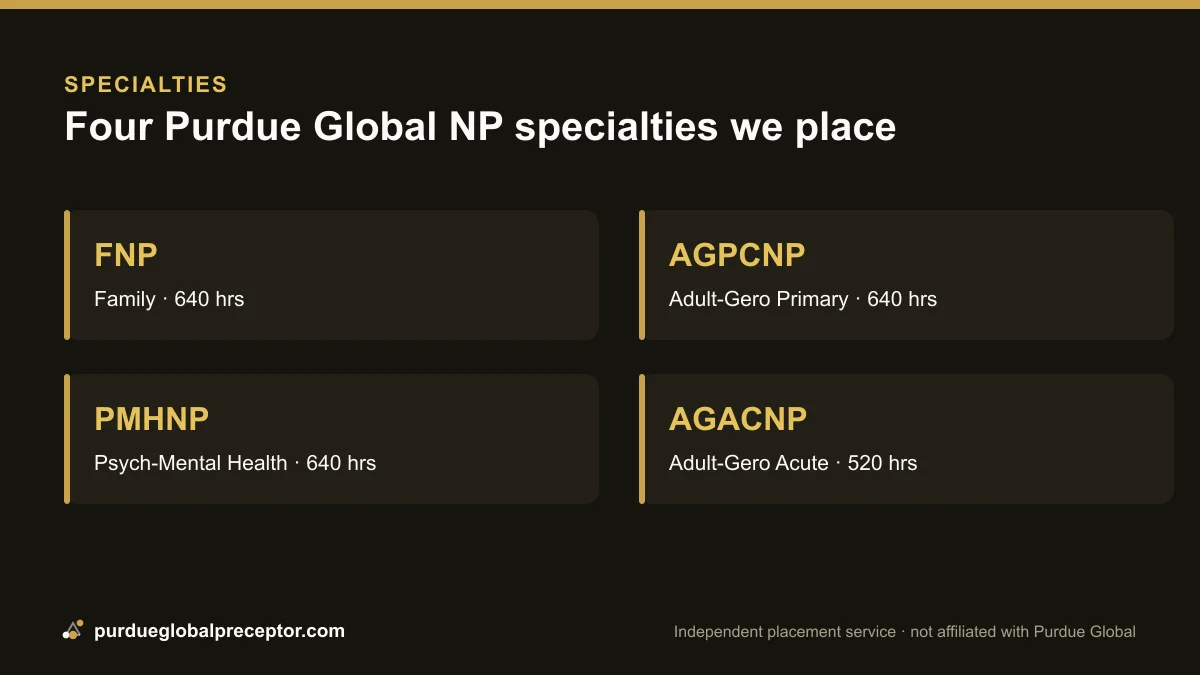
The four MSN nurse practitioner tracks
Purdue Global runs four NP specialty tracks at the master's level. The coursework is fully online and the same advocacy model applies to each: you identify the site, the University and your Clinical Student Manager support you, and a clinical affiliation agreement has to be in place between the site and Purdue Global before you start hours. We source the preceptor and move that paperwork so the agreement does not become the thing that delays your start.
Family Nurse Practitioner (FNP)
The FNP track prepares you for primary care across the lifespan, from pediatrics through older adults. It is the broadest of the four tracks, which usually means you have the widest range of clinical settings to draw on for placement: family practice, community clinics, urgent care, and more. The clinical hour requirement commonly published for this program is 640 hours; we confirm the exact requirement against your current Purdue Global handbook. See FNP preceptor help for how we approach family-practice placements.
Adult-Gerontology Primary Care (AGPCNP)
The AGPCNP track focuses on primary care for adolescents through older adults, including the chronic conditions that dominate adult and geriatric practice. Placement typically happens in internal medicine, family practice, and geriatrics settings. The clinical hour requirement commonly published for this program is 640 hours; we confirm the exact requirement against your current Purdue Global handbook. Start with AGPCNP preceptor help.
Psychiatric Mental Health (PMHNP)
The PMHNP track prepares you to assess, diagnose, and treat mental health conditions across the lifespan, including medication management and therapy. Qualified psychiatric preceptors are in genuinely short supply nationally, so this track rewards starting your search early. The clinical hour requirement commonly published for this program is 640 hours; we confirm the exact requirement against your current Purdue Global handbook. See PMHNP preceptor help or our psychiatric NP placement page.
Adult-Gerontology Acute Care (AGACNP)
The AGACNP track prepares you for higher-acuity adult and geriatric care in settings like hospitals, intensive care, and specialty units. Because acute-care preceptors and credentialed hospital sites are harder to line up, the affiliation agreement timeline matters even more here. The clinical hour requirement commonly published for this program is 520 hours; we confirm the exact requirement against your current Purdue Global handbook. See AGACNP preceptor help.
How to choose the right track page for your search
The four tracks are not interchangeable when it comes to placement, so the page you start from should match the kind of preceptor you actually need to credential. The split that matters most is primary care versus acute care: a primary-care preceptor (FNP, AGPCNP) practices in an ambulatory, outpatient setting, while an acute-care preceptor (AGACNP) has to hold privileges at a hospital or higher-acuity unit, which is a narrower and slower-to-credential pool.
Within primary care, FNP and AGPCNP overlap heavily in adult medicine but diverge at the edges: FNP needs pediatric and women's-health exposure that AGPCNP does not, while AGPCNP leans harder into geriatrics and complex chronic disease. That difference changes which clinics can host you, so we match you to a site that can actually sign off on the population focus your program requires rather than just any open preceptor.
PMHNP sits on its own. A psychiatric preceptor must be a licensed mental-health prescriber, and that population is small relative to demand, so we treat PMHNP searches as the longest-lead of the four and open them first. If you are early in the program, tell us your track now even before you need hours, so we can be working the affiliation agreement while you finish coursework.
Each track page below goes deeper on the settings, preceptor types, and common hurdles for that focus. Use the one that matches your enrollment, and if you are unsure, the find a preceptor page is a good neutral starting point. For the full hour requirements for all four tracks in one place, see clinical hours. And before you commit outreach hours to any candidate, check them against the preceptor requirements so a mismatch does not surface at verification time.
Post-master's certificates and the online DNP
If you already hold an MSN, Purdue Global offers post-master's certificates in the same four tracks: FNP, AGPCNP, PMHNP, and AGACNP. A certificate adds NP scope in a new population focus rather than repeating a full degree, so the coursework is shorter, but the clinical practicum and the placement work are the same kind of problem you would face as a degree-seeking student.
That means the same advocacy model applies: you still need a real preceptor at a real site, and that site still needs a clinical affiliation agreement with Purdue Global before you log hours. Certificate students sometimes assume the placement is lighter because the coursework is, but the site-credentialing and agreement steps do not shrink, they are tied to the population focus, not the degree length. The track pages above apply to certificate students as well, so use the link that matches your certificate focus.
Not sure which track fits, or pursuing something outside these four? Tell us your specialty on the contact page and we will tell you honestly whether we can help.
Beyond the certificates, Purdue Global also offers an online Doctor of Nursing Practice. The DNP is CCNE accredited, and the commonly published requirement is a minimum of 1,000 postbaccalaureate practicum hours, a larger practicum problem than any single MSN track, so the same early-start logic applies with even more force. Our four track pages are written for the MSN programs, but we take DNP placement inquiries as well, tell us your program and remaining hours on the contact page and we will tell you honestly whether we can help.
Why your timeline depends on the agreement, not the track
Whichever specialty you are in, the slowest moving part is rarely the coursework, it is the clinical affiliation agreement between your chosen site and Purdue Global, which has to be signed before you log a single hour. A site that already holds an agreement can move quickly; a brand-new site has to negotiate one from scratch, which is why acute-care and psychiatric placements that pull in unfamiliar sites tend to take the longest. For the full timeline ranges and what the agreement actually covers, see how affiliation agreements work, and read the full how it works process to see how we run sourcing and paperwork in parallel. If you want that logic laid out month by month, our practicum timeline turns it into a working back-plan.
Purdue Global nursing programs we support
| Program | Population focus | Hours (commonly published) |
|---|---|---|
| MSN, FNP | Family, across the lifespan | 640 |
| MSN, AGPCNP | Adult-gerontology primary care | 640 |
| MSN, PMHNP | Psychiatric, mental health | 640 |
| MSN, AGACNP | Adult-gerontology acute care | 520 |
| Post-master's certificates | The same four population foci | Tied to the track |
| Online DNP | Practice doctorate, CCNE accredited | Minimum 1,000 postbaccalaureate |
Sources: Purdue Global Catalog, MSN NP tracks · Purdue Global Catalog, DNP (1,000 hours) · Purdue Global, Online DNP program · Purdue Global, CCNE reaccreditation (2026)
Good to know
Which Purdue Global NP tracks do you place students in?
All four MSN nurse practitioner tracks: Family (FNP), Adult-Gerontology Primary Care (AGPCNP), Psychiatric Mental Health (PMHNP), and Adult-Gerontology Acute Care (AGACNP). We also work with post-master's certificate students in those same four focuses.
Does Purdue Global offer a DNP?
Yes. Purdue Global offers an online Doctor of Nursing Practice, and the program is CCNE accredited, with a commonly published minimum of 1,000 postbaccalaureate practicum hours, confirm your exact requirement against your current handbook. Our track pages focus on the four MSN NP tracks, but we take DNP placement inquiries too, tell us your program on the contact page.
How many clinical hours will I need?
It depends on your track, and the figures are commonly published rather than guaranteed, we confirm the exact requirement against your current Purdue Global handbook, since your catalog year can affect it. See clinical hours for the per-track requirements in one place.
Are you part of Purdue Global?
No. We are an independent clinical-placement service for Purdue Global MSN nurse practitioner students.
Which track has the hardest placements?
Psychiatric (PMHNP) and acute care (AGACNP) tend to be the toughest, because qualified preceptors and credentialed sites are scarcer. Both reward starting your search early, which is exactly why we run preceptor sourcing and the affiliation agreement in parallel.
Get matched with a
Purdue Global preceptor
Tell us your track, your city, and your term. We'll come back with a placement plan and a realistic date your affiliation agreement can clear by.