PMHNP Preceptor Placement for Purdue Global Students
If you are in the Purdue Global Psychiatric-Mental Health Nurse Practitioner track, the coursework runs online but the practicum is local, in person, and supervised by a qualified psychiatric clinician you have to find. Psych preceptors are some of the hardest to secure on your own, partly because the pool of board-certified PMHNPs and psychiatrists is smaller than primary care, and partly because behavioral health settings are protective about who works with their patients. We are an independent placement service. We source the preceptor, confirm the site qualifies, and push the clinical affiliation agreement through so your start date does not slip. We are not Purdue University, Purdue Global, or the CCNE.
Last updated July 2026. Verified against the current Purdue Global nursing handbook.
Get matched, free
Tell us your track and city, we'll plan your placement. No payment until you're matched.
What the PMHNP practicum requires
Purdue Global's PMHNP track is delivered as a Master of Science in Nursing with 100 percent online coursework and a local, in-person practicum. The clinical portion is where you apply psychiatric assessment, diagnosis, and treatment under the supervision of an approved preceptor. Coursework alone does not finish the degree; the supervised clinical hours do.
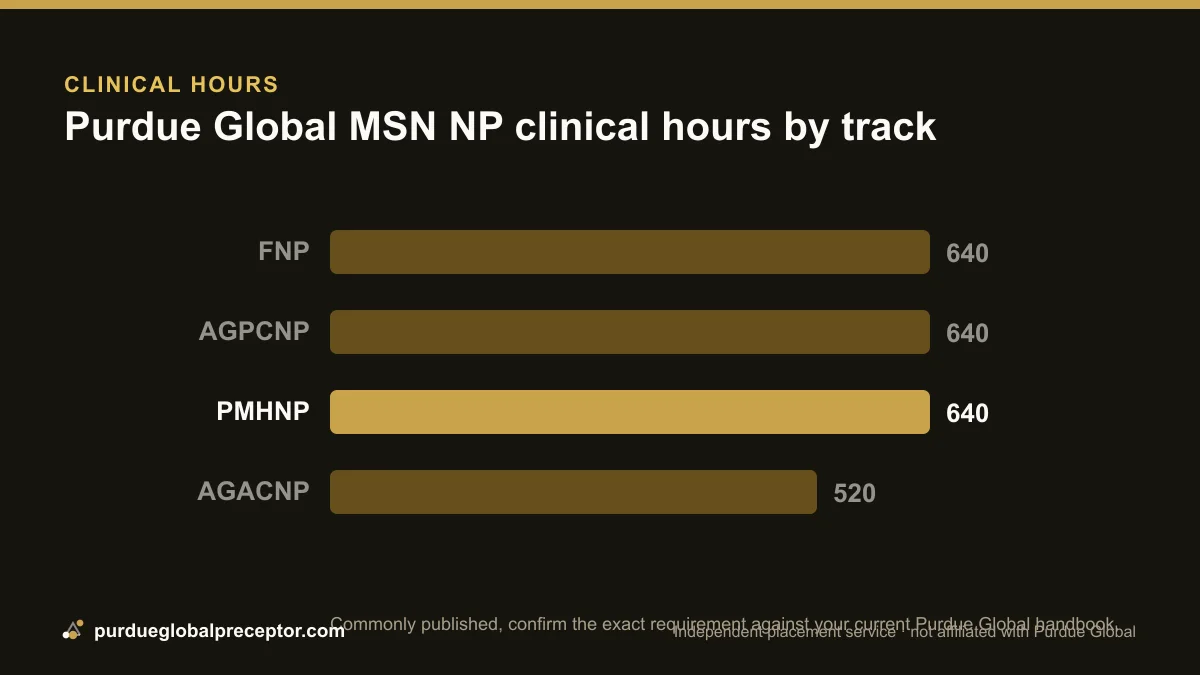
The PMHNP practicum commonly carries 640 clinical hours. That figure is commonly published for this program; we confirm the exact requirement against your current Purdue Global handbook before we build your plan, because requirements can change by cohort and catalog year. Purdue Global uses a quarter-credit system, so the way hours map to terms is worth checking with your Clinical Student Manager early.
Psychiatric-mental health is a population-focused specialty, which means your hours are generally expected to span the lifespan. In practice that usually involves exposure to several age groups and a mix of presentations rather than a single narrow clinic. We keep that breadth in mind when we match you, so one placement, or a deliberately sequenced pair of placements, covers the range your program expects to see. We confirm the specific breadth your handbook calls for rather than assuming.
Who can precept a Purdue Global PMHNP student
For a psychiatric practicum, the preceptor needs to be qualified to supervise psychiatric care and be practicing within that scope. In plain terms, that almost always means one of two clinicians:
- A board-certified Psychiatric-Mental Health Nurse Practitioner who is actively practicing in behavioral health.
- A psychiatrist (physician) practicing within psychiatric scope.
What does not work is borrowing a preceptor from a different specialty. A family nurse practitioner, however excellent, is not an appropriate fit for psychiatric hours, just as a PMHNP would not be the right supervisor for a family-practice rotation. Scope alignment is the first thing a program checks, so it is the first thing we confirm before we ever propose a site to you.
Your program holds final approval over any preceptor and site. We do the legwork of finding and vetting candidates and assembling the documentation; the University signs off. We confirm credential and scope details against your current Purdue Global handbook rather than assuming, because the precise wording of who qualifies belongs to the program, not to us.
Outpatient, inpatient, and the settings that count
Psychiatric hours can come from a range of behavioral health settings, and a good plan usually blends them so you graduate having seen more than one kind of care. Common environments include:
- Outpatient behavioral health, community mental health clinics, private psychiatric practices, and group practices where you see medication management and follow-up visits across a full caseload.
- Inpatient and acute psychiatric units, hospital-based behavioral health, crisis stabilization, and higher-acuity settings where presentations are more severe and the pace is different.
- Specialized programs, substance use treatment, integrated primary-care-plus-behavioral-health models, and settings serving specific age groups, depending on what your program accepts.
The right mix depends on what your handbook requires and what is realistically available near you. We do not push you toward whatever is easiest to staff; we work toward placements that satisfy your hour and population requirements while giving you genuinely useful clinical exposure.
Telepsych: when it counts, and when it doesn't
Telepsychiatry is now a normal part of behavioral health, and some psychiatric practicums allow a portion of hours to be earned in a telehealth setting. This can widen your options, especially if you live somewhere with few in-person psychiatric practices. But it is not automatic.
Two things govern whether telepsych counts for you. First, your program's policy on telehealth practicum hours, which we confirm against your current Purdue Global handbook rather than guessing. Second, the preceptor's setup, the supervising clinician still has to be present and actively supervising the encounters, not simply sharing a login. If your program allows telepsych and we find a qualified preceptor running a compliant telehealth practice, we will pursue it. If it does not, we focus on in-person placements so your hours are never at risk of being rejected after the fact.
One practical note specific to psychiatry: even where telehealth is permitted, a hybrid plan tends to be the safest. A block of in-person hours protects you if a site's policy shifts mid-rotation, while telehealth hours fill in the gaps when local in-person capacity is thin. We design the mix around what your handbook accepts, not around what is merely convenient to schedule.
Why psych preceptors are hard to find solo
Most PMHNP students discover that cold outreach works far worse for psychiatry than for primary care. There are simply fewer board-certified psychiatric NPs and psychiatrists than there are family practice clinicians, so the supply is thinner to begin with. On top of that, behavioral health settings are unusually cautious about bringing in a student, because patient confidentiality and the sensitivity of psychiatric encounters raise the bar for who they will let observe and participate.
Purdue Global expects you to take point on identifying clinical sites and preceptors, with the University and your Clinical Student Manager backing you up. For psychiatry, that often translates into one student emailing a thin list of practices and waiting on replies that may never come. We run that outreach as your standing partner instead: we keep working relationships with psychiatric clinicians warm, we make the introduction on your behalf with a clear and professional ask, and we always have more than one candidate in motion so a couple of declines do not reset your timeline to zero.
There is also a quieter reason the search drags for psych students: many qualified PMHNPs and psychiatrists already carry a student or two and decline on capacity alone, not on fit. Because we track who has openings rather than guessing, we spend your weeks approaching clinicians who can actually say yes. If you want to understand the full sequence from first contact to a signed placement, see how it works. To start a search near you, see preceptor near me.
What slows a psychiatric placement
Finding a willing psychiatric clinician is only half the job, and for behavioral health it is often not even the slowest half. Two things tend to hold a confirmed psych placement back, and both reward starting months ahead rather than weeks.
The first is the signed clinical affiliation agreement between the site and Purdue Global, turnaround runs roughly two to four weeks when a site already holds one and closer to one to two months or more when it has to be negotiated from scratch, which is exactly why we open that paperwork track the moment a site says yes.
The second is unique to behavioral health: small psychiatric practices and community mental health agencies frequently run lean, with one or two prescribers and no spare administrative bandwidth to onboard a student quickly. A clinician can be willing and still need weeks to clear it internally, secure unit or medical-director approval, and confirm their malpractice coverage extends to supervising a student. We manage those moving parts in parallel so the human yes turns into a real start date instead of stalling in someone's inbox. For how the full timeline maps against your clinical hours, plan to begin your search well before the term you intend to start.
Compliance you'll need in place
Behavioral health sites tend to be strict about onboarding before they let a student work with patients, and psychiatric settings often add their own privacy and safety requirements on top of the standard list. Lining these up early keeps a confirmed placement from stalling on paperwork. Beyond the signed affiliation agreement, plan on:
- Background check and immunization clearance, kept current through your start date, since behavioral health and hospital sites frequently require these before you can be scheduled.
- Site-specific onboarding, orientation, confidentiality and HIPAA acknowledgments, and any unit-level requirements a psychiatric setting asks of students.
- Hour logging, your supervised hours recorded in your program's clinical tracking system as you complete them, so your documentation is never the thing holding up sign-off.
We help you sequence these so nothing surfaces at the last minute. For the full picture of what to prepare, see clinical compliance.
PMHNP practicum and preceptor at a glance
| Practicum hours (commonly published) | 640 hours, confirmed against your current handbook |
|---|---|
| Population focus | Psychiatric, mental health across the lifespan |
| Typical settings | Outpatient behavioral health, inpatient and acute psychiatric units, specialized programs; telepsychiatry where your handbook allows |
| Qualifying preceptor | Board-certified PMHNP, or a psychiatrist practicing within psychiatric scope |
| Affiliation agreement | About 2 to 4 weeks if the site holds one, commonly 1 to 2 months for a new site |
Sources: Purdue Global Catalog, MSN NP tracks · NCSBN, APRN Consensus Model · NONPF, NP Role Core Competencies · Purdue Global, Tips to Find a Clinical Placement
Good to know
How many clinical hours does the Purdue Global PMHNP track require?
The PMHNP practicum commonly carries 640 clinical hours. That number is commonly published for this program; we confirm the exact requirement against your current Purdue Global handbook before finalizing your plan, since requirements can vary by cohort and catalog year.
Can a family nurse practitioner precept my psychiatric hours?
No. Psychiatric hours need a preceptor qualified in that scope, typically a board-certified Psychiatric-Mental Health NP who is actively practicing in behavioral health, or a psychiatrist practicing within psychiatric scope. Your program confirms preceptor eligibility; we vet for scope alignment before proposing anyone.
Do telepsychiatry hours count toward my practicum?
Sometimes. It depends on your program's telehealth policy and on the preceptor's setup, since the supervising clinician must be present and actively supervising the encounters. We confirm the policy against your current Purdue Global handbook. If telepsych is allowed and we find a compliant practice, we'll pursue it; if not, we focus on in-person placements.
Why are psychiatric preceptors harder to find than primary care?
There are fewer board-certified psychiatric NPs and psychiatrists than family practice clinicians, so supply is thinner. Behavioral health settings are also more protective about who observes and participates in psychiatric encounters, and small psych practices often run lean on capacity. We approach qualified clinicians on your behalf and keep multiple options moving so the search doesn't stall.
Are you affiliated with Purdue Global?
No. We are an independent clinical-placement service. We are not Purdue University, Purdue Global, or the CCNE, and we don't represent or speak for them. We work alongside you and your Clinical Student Manager to source a qualified preceptor and move the affiliation paperwork forward.
How long does the affiliation agreement take?
If the site already holds an agreement with Purdue Global, usually about two to four weeks. For a brand-new site negotiating one from scratch, roughly one to two months or longer. Starting early is the single best way to protect your start date, which is why we open the paperwork track as soon as a site agrees.
Get matched with a
Purdue Global preceptor
Tell us your track, your city, and your term. We'll come back with a placement plan and a realistic date your affiliation agreement can clear by.