How to Find a Purdue Global Preceptor
Purdue Global asks you to be the lead advocate for your own clinical placement, supported by the University and a Clinical Student Manager. That is a real job, and it is doable. This page is the honest do-it-yourself playbook: when to start, who to ask, what makes a preceptor qualify, and the paperwork that actually gates your start date. Read it, use it, and decide for yourself whether you want help.
Last updated July 2026. Verified against the current Purdue Global nursing handbook.
Get matched, free
Tell us your track and city, we'll plan your placement. No payment until you're matched.
Start 4 to 6 months before your clinical term
The single biggest predictor of a smooth placement is how early you start. The bottleneck is rarely finding a willing clinician; it is the paperwork. The clinical affiliation agreement between the site and Purdue Global is what gates your start date, and how long it takes depends entirely on whether the site already holds one (see the full timeline on the agreement page).
Work backward from your clinical start date and add a buffer. Four to six months ahead is not cautious, it is realistic. That window lets you absorb a preceptor who backs out, a site whose agreement stalls in legal review, or a background check and immunization clearance step you did not see coming. Students who start a few weeks out are the ones most likely to defer a term. Build a simple tracker the day you begin: a row per lead with the clinician's name, the practice manager, the date you last reached out, and the next follow-up date. The students who place themselves successfully are almost never the ones with the best network; they are the ones who never let a thread go cold.
Confirm your own number first. Your track sets the target, and you should map it to days per week before you ask anyone to host you. For most students that target is commonly published as 640 clinical hours; Adult-Gero Acute Care is commonly published lower. Treat any figure as commonly published and confirm the exact requirement against your current Purdue Global handbook. The full per-track breakdown lives on the clinical hours page. Purdue Global runs on a quarter-credit system, so map your hours to the term calendar, not a semester one, then divide by the number of weeks you actually have a site to see the weekly load a clinician is signing up for.
Who to ask, and how to ask well
Your network is wider than it feels. Start with the people who already know your work, then expand outward. The strongest leads usually come from someone who has met you in person.
- Your own clinicians and coworkers. If you work in healthcare, your charge nurse, a friendly NP, or the physician you round with is the warmest possible lead. They already trust you.
- Your primary care provider and specialists you see. A clinic where you are a patient is a natural ask, especially for primary care tracks.
- Alumni and classmates. Other Purdue Global students and graduates in your area know which local sites are open to students and which to skip.
- Local clinics, urgent care, community health centers, and FQHCs. Federally qualified health centers and community clinics are often more receptive to students than large hospital systems with rigid central approval.
- For PMHNP, look beyond hospitals. Outpatient psychiatry, community mental health centers, addiction medicine, and telepsychiatry practices all host psych students.
When you reach out, be specific and make it easy to say yes. Lead with your track, the term and number of hours you need, the days you are available, and a clear statement that you handle the paperwork. A short, professional email or a printed one-page letter you can hand over in person works better than a vague phone call. Ask the clinician directly, but copy or follow up with the practice manager, because the manager is usually the person who routes an affiliation agreement to whoever signs it.
Match the ask to your track. A family medicine office fits FNP and AGPCNP. A hospitalist or critical-care team fits AGACNP. You can read what each track typically needs on the FNP, Adult-Gero Primary Care, Adult-Gero Acute Care, and Psych Mental Health pages. If a clinician in your circle is open to the idea but wants to understand their side of the commitment first, send them our become a preceptor page, it answers exactly that.
What makes a preceptor actually qualify
A willing clinician is not automatically an approved preceptor. Before you invest weeks chasing a site, confirm the basics so you do not get a no from your program later.
- An active, unencumbered license in your state of practice.
- Credential alignment with your track. Generally a board-certified NP in the same population focus, or a physician, depending on the rotation and your program's current rules. Match matters most for specialty rotations.
- Enough patient volume and the right population so you can realistically log your hours in the time you have.
- A site willing to enter or already holding an affiliation agreement with Purdue Global. Whether the site already holds one is the single biggest factor in how fast you start; see the affiliation agreement guide for what the agreement covers and how long each path takes.
- Time and willingness to teach and to sign off on your hours in your program's clinical tracking system.
Your Clinical Student Manager is the right person to verify a preceptor and site against current program requirements. Bring them a candidate early rather than committing to someone first and asking permission second. If your preceptor's focus does not perfectly match your population, ask before you assume it disqualifies them, because some rotations allow more flexibility than others. For tighter specialty matches, see specialties. The full credential-by-credential breakdown, including who can precept each of the four tracks, lives on our preceptor requirements page.
Why you might need more than one preceptor
Plan for the possibility that one preceptor will not carry your whole practicum, because for many students one does not. Four reasons come up again and again:
- Your hours usually span more than one practicum course. An NP hour requirement is commonly spread across multiple practicum terms rather than logged in one block, and how the split works is set by your current Purdue Global handbook, so confirm with your Clinical Student Manager whether each course needs its own confirmed preceptor before you assume one yes covers everything.
- Population coverage. An FNP practicum needs pediatric and women's-health exposure that a single adult-focused clinic may never provide, so a second site often is not a failure of planning, it is the plan.
- Preceptor capacity. A willing clinician who can host you two days a week may simply not have the patient volume or schedule to carry your full requirement inside your term dates.
- Risk cover. Preceptors change jobs, clinics get acquired, and agreements stall. A second thread already warm is the cheapest insurance a placement can have.
The practical move is to keep two or three candidate threads alive until your hours are fully covered, and to map each candidate against your term dates using the practicum timeline. If a candidate looks promising but you are unsure they would survive verification, the preceptor requirements page is the checklist to read before you invest another follow-up.
The agreement and compliance steps that gate your start
Once you have a willing, qualified preceptor, two parallel tracks decide whether you start on time. Run them at the same time, not one after the other.
The affiliation agreement
Ask the site one question on the first call: do you already hold a clinical affiliation agreement with Purdue Global? The answer decides which timeline you are facing, and the affiliation agreement guide lays out both in full. Your job here is to keep it moving. Get the practice manager's email, not just the clinician's, because the manager is the person who routes a new agreement to whoever signs it. Hand them the correct University contact promptly so the two offices talk to each other directly instead of relaying messages through you. Then check in politely every few days, name a specific next step in each message, and ask what is blocking signature rather than asking for a status. A stalled agreement is the most common reason a placement slips, and it is almost always fixable with earlier, more concrete follow-up.
Your compliance file
While the agreement moves, get your own clearances done so you are not the one holding things up. That generally means a background check and immunization clearance, plus any site-specific onboarding the practice requires, such as HIPAA training, a drug screen, or an orientation. Some sites add their own steps on top of the University's. Start these the moment you have a likely site, because lab turnaround and document gathering take longer than people expect. See clinical compliance for the typical checklist, and confirm the exact list in your current handbook and your program's clinical tracking system.
Doing it yourself versus using a preceptor finder service
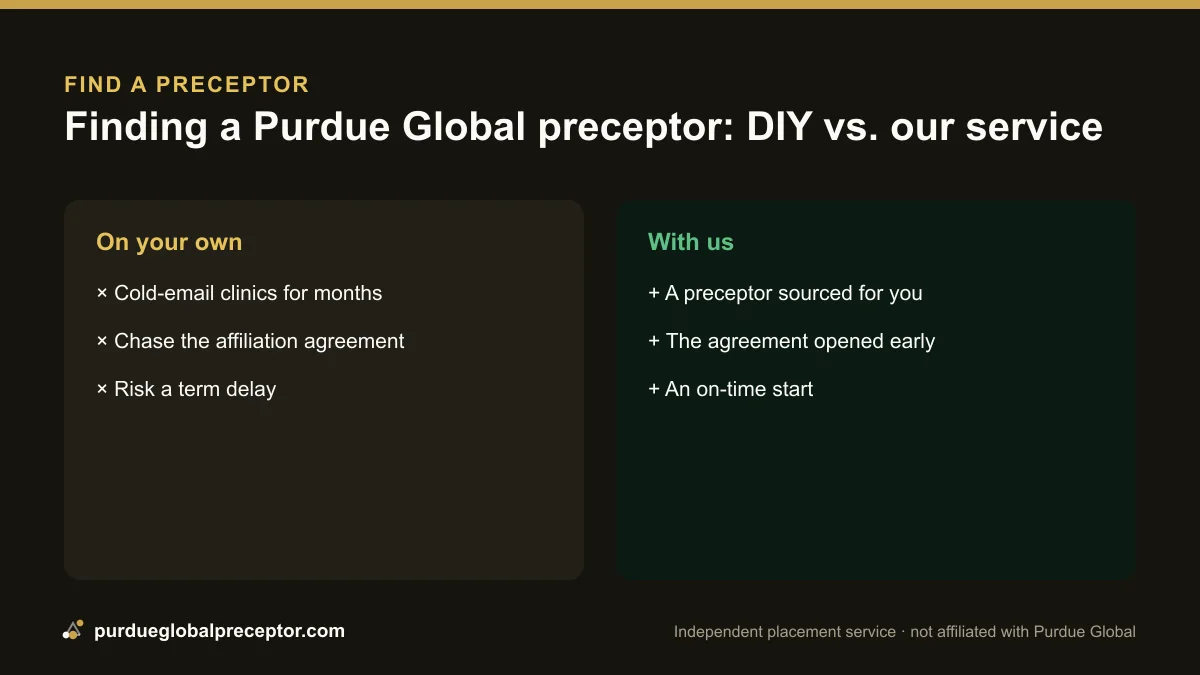
You can absolutely place yourself. Many Purdue Global students do, especially if they already work in healthcare and have warm leads. The playbook above is the whole method, and we would rather you use it than pay for help you do not need.
The honest case for doing it yourself: it costs nothing, you keep full control, and a clinician you already know is the easiest yes there is. The honest cost: it is time and persistence on top of full-time coursework and often a job. The hard part is rarely the first email. It is the dozen follow-ups, the cold outreach when your network runs dry, and the affiliation agreement that sits in a legal inbox while your term creeps closer.
Where we help is exactly there. We do the advocacy with you, not instead of you. We source a willing, track-matched preceptor in your area, then move the affiliation-agreement and compliance paperwork forward so it does not stall. You stay the student of record and your Clinical Student Manager still verifies and approves the match, the same as if you found it yourself. We do not replace the University's process, we keep it moving.
A fair way to decide: if you have a strong lead and the lead time to chase it, start with this page and the how it works overview, and place yourself. If you have already sent emails and gotten silence, if your term is closing in, or if you simply do not have the hours to manage the chase, that is the moment to reach out. You can review what is included and the cost before committing to anything.
Month-by-month placement back-plan
| When (before your term) | Focus |
|---|---|
| 6 to 5 months | Confirm your hour requirement, build a lead tracker, start warm outreach |
| 5 to 4 months | Widen to cold outreach; ask every site whether it already holds a Purdue Global agreement |
| 3 months | Pick a lead site and open the affiliation agreement, since a new site needs its 1 to 2 months now |
| 2 months | Run compliance in parallel: background check, immunizations, and BLS |
| 1 month | Confirm the signed agreement, verify the preceptor cleared, and map weekly clinic days |
| Term start | Log hours from week one |
Sources: Purdue Global, Tips to Find a Clinical Placement · Purdue Global, Online Nursing Programs (accreditation)
Good to know
How early should I start looking for a Purdue Global preceptor?
Four to six months before your clinical term. The slow step is the affiliation agreement between the site and Purdue Global, not finding a willing clinician. Starting early gives you room to recover if a preceptor backs out or an agreement stalls in a legal office.
Does Purdue Global find my preceptor for me?
Not directly. Purdue Global asks the student to be the lead advocate for identifying clinical sites and preceptors, supported by the University and a Clinical Student Manager. The University assists and verifies, but the search is largely yours to drive, which is why an early, organized approach matters.
How long does the clinical affiliation agreement take?
It depends entirely on whether the site already holds an agreement with Purdue Global, which is why the first question to ask any site is whether one is already in place. The full timeline for both paths is on the affiliation agreement guide. From a search standpoint, the practical takeaway is to favor sites that already have an agreement when your term is close.
What makes someone a qualified preceptor?
Generally an active, unencumbered license, credentials that align with your track, enough patient volume in the right population, willingness to teach and sign off on your hours, and a site that holds or will enter an affiliation agreement with Purdue Global. Your Clinical Student Manager confirms the exact requirements against current program rules.
Is using your service the same as being affiliated with Purdue Global?
No. We do the sourcing and paperwork advocacy with you, while your Clinical Student Manager still verifies and approves every match through the University's own process.
How do I find a Purdue Global preceptor?
Follow the playbook on this page: begin four to six months out, tap the clinicians who already know your work before going cold, and ask every site whether it already holds an agreement with Purdue Global. Build a simple tracker and never let a lead thread go cold, because persistence, not the size of your network, is what places students. If you would rather not run that chase on top of coursework, our placement service does the sourcing and paperwork advocacy with you.
Is Purdue Global Preceptor a preceptor finder service?
Yes. Purdue Global Preceptor is an independent preceptor finder service, meaning that when you would rather not do the outreach yourself, we locate a qualified, track-matched preceptor for your MSN practicum and then carry the affiliation agreement and compliance steps forward. This page is the honest do-it-yourself version of that same work, so you can choose to place yourself or hand it to us.
Can you help me find a preceptor near me or in my state?
Yes. We prioritize sites within driving distance in your own city and state, and we check which of them already hold a Purdue Global affiliation agreement so your clearance moves faster. For PMHNP students that often means outpatient psychiatry, community mental health, and telepsychiatry practices near you, not just hospitals. Share your track and location and we will map the closest realistic options before planning your placement.
How do I get or secure a preceptor for my Purdue Global program fast?
The fastest path is to favor sites that already hold an agreement with Purdue Global and to run your compliance file, background check, immunizations, and any site onboarding, in parallel rather than one step at a time. A stalled affiliation agreement is the most common reason a start date slips, so keep it moving with concrete, every-few-days follow-up. When speed matters most, we open the agreement the moment a site is identified and track it to signature so nothing sits idle.
What is the best way to find a Purdue Global preceptor?
The best method is the back-plan on this page: work backward from your term, keep two or three qualified leads warm at once, and confirm credentials and agreement status before you commit to any single site. Warm introductions beat cold emails almost every time, so start with people who have seen your work. If the follow-ups pile up or your term is closing in, our placement service is the reliable shortcut, sourcing the preceptor and moving the paperwork alongside your Clinical Student Manager.
Do you place preceptors for Purdue Global students, or just refer them?
We place rather than refer. A lead-referrer sells you a name and leaves the affiliation agreement, compliance, and follow-through on your shoulders, while we source a track-matched preceptor and then advance the agreement and compliance paperwork to a confirmed start. You remain the student of record, your Clinical Student Manager verifies and approves the match, and there is no payment until you are matched.
Get matched with a
Purdue Global preceptor
Tell us your track, your city, and your term. We'll come back with a placement plan and a realistic date your affiliation agreement can clear by.