Clinical Compliance and Onboarding for Your Purdue Global Practicum
Before you can log a single clinical hour at your practicum site, you have to clear compliance. It is the quiet step that decides whether your start date holds. This guide walks through what most Purdue Global MSN nurse practitioner students are asked to complete, roughly how long it takes, how one expired document can stall an already-approved placement, and how we keep the paperwork moving so your start date does not slip. We are an independent clinical-placement service and are not Purdue University, Purdue Global, or the CCNE; always confirm specifics against your current Purdue Global handbook and your Clinical Student Manager (CSM).
Last updated July 2026. Verified against the current Purdue Global nursing handbook.
Get matched, free
Tell us your track and city, we'll plan your placement. No payment until you're matched.
What clinical compliance actually means
Clinical compliance is the set of health, safety, and legal clearances you complete so a site will let you treat patients and so the school will let you count the hours. Two parties are checking boxes at once. Purdue Global has its own onboarding requirements for every student entering a practicum, and the clinical site has its own requirements for anyone who walks its halls. You have to satisfy both, and the lists usually overlap but are rarely identical.
Most students are surprised that compliance is separate from the clinical affiliation agreement and from preceptor approval. You can have a confirmed preceptor and a signed agreement and still be blocked at the door because a titer came back equivocal or a CPR card lapsed. Treat compliance as its own track that runs alongside everything else, not as an afterthought you handle the week before you start.
All of these items are documented through your program's clinical tracking system, which is where you upload proof and where your reviewer signs off. Nothing counts as done until it is approved there, no matter how many vaccines you have actually had or how clean your record actually is.
The items you are usually asked to complete
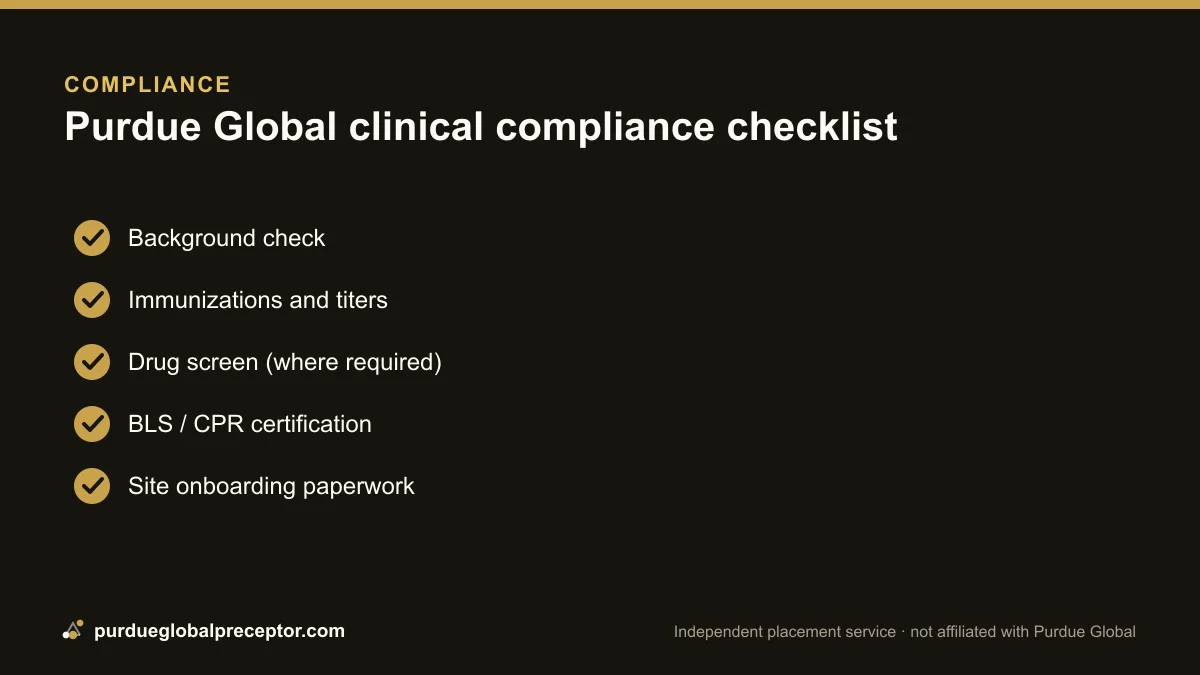
Exact requirements vary by track, by site, and by your state, so use this as a working list and confirm the specifics with your CSM and current handbook. For most Purdue Global NP students, onboarding includes the following.
- Background check. A criminal background screen, often at both the national and county level, and frequently checked against healthcare exclusion lists. Some sites require a fresh check rather than accepting one done for your RN license years ago.
- Immunizations and titers. Proof of MMR, varicella, hepatitis B, and Tdap, usually confirmed by titer (a blood test showing immunity) rather than just a vaccine record. An annual flu shot is common in season, and tuberculosis screening (a two-step PPD or a blood test such as an IGRA) is nearly universal.
- Drug screen. Not every site requires one, but many do, typically a urine panel completed close to your start date.
- BLS or CPR certification. A current Basic Life Support card, most often the American Heart Association version. Some acute or specialty settings ask for more, and the card must be valid through your entire rotation.
- Site-specific onboarding paperwork. HIPAA acknowledgment, a confidentiality agreement, bloodborne-pathogen and safety training, an N95 fit test for some settings, occasionally an EHR access form or a short site orientation.
- Identification and licensure. A copy of your active, unencumbered RN license, a government photo ID, and sometimes a current photo for a site badge.
If your track is acute-care focused, expect a heavier list. AGACNP placements in hospitals tend to layer on extra safety training and access requirements that primary-care sites do not.
We do not name a specific background-check or compliance vendor here because the requirement is what matters, not the brand. Your CSM will tell you exactly which background check and immunization clearance to use and where to submit it.
How long compliance takes
Plan for two to four weeks from the day you start to the day everything is cleared, and treat that as a floor, not a guarantee. The fast pieces, signing paperwork and uploading documents you already have, can be done in an afternoon. The slow pieces set the real timeline.
Titers are the usual culprit. If a titer comes back negative or equivocal, you may need a booster and then a repeat titer weeks later, which can add a month on its own. A two-step TB test requires two visits spaced one to three weeks apart before it is even valid. Background checks can clear in days or sit for two weeks if a county court is slow to respond. A drug screen is quick, but only once you schedule and complete it.
Because these run on outside labs and courts, you cannot compress them by trying harder at the end. The only real lever is starting early. Compliance also runs in parallel with the paperwork covered on the clinical affiliation agreement page, so treat both as separate clocks that need to finish before your clinical hours can begin. A practical sequencing rule: book your titer draws and any two-step TB visit in week one, since those have the longest tails, and leave the same-day paperwork for whenever a free hour appears.
How one expired item can stall an approved placement
Here is the scenario that derails confirmed placements. Your preceptor is locked, the affiliation agreement is signed, your start date is on the calendar, and then a single document fails its date check. A BLS card that expires the week after you start. A TB test that is now older than a year. A flu shot that was due in the new season. The site cannot let you onboard until that one item is current, and your start date moves while you re-test, re-certify, and re-upload.
The math is unforgiving because compliance items expire on their own clocks. Background checks and drug screens are often only valid for a set window before your start. Titers do not expire, but the booster process does take time. CPR cards run on a roughly two-year cycle that rarely lines up with your term. We watch every expiration date against your actual start date so the longest, slowest item is the one we start first, and so nothing quietly lapses between approval and day one.
Your compliance checklist
Use this as a running checklist and confirm the exact items with your CSM and current Purdue Global handbook. Aim to have everything approved before your start date, not on it.
- Active, unencumbered RN license on file, plus a government photo ID
- Background check completed within the site's accepted window
- Drug screen completed if your site requires one
- MMR, varicella, hepatitis B, and Tdap confirmed, by titer where required
- Annual flu vaccination if you are starting in flu season
- TB screening complete and current (allow for the two-step timeline)
- Current BLS or CPR card valid through the end of your rotation
- HIPAA, confidentiality, and bloodborne-pathogen or safety training signed
- N95 fit test if your setting requires it
- Site-specific onboarding forms and any EHR access request submitted
- Every item uploaded and marked approved in your clinical tracking system
Print this, or keep it open, and check off each item the day it clears rather than trusting memory. The students who start on time are the ones who treated this list as a project with a deadline.
How we keep it moving
When we source your preceptor and move your paperwork, compliance is part of the same workflow, not a separate scramble. We map your full requirement list against your target start date, then sequence the slow items first so titers, TB screening, and background checks are in motion while the quick paperwork waits.
We track each item's status and expiration so nothing lapses in the gap between approval and your first day, and we flag a re-test or a booster the moment a result comes back short, while there is still time to fix it. We coordinate the site-specific forms directly with your practicum site so its requirements and Purdue Global's requirements are satisfied together.
Compliance is methodical work, and most stalls come from doing it late, not from doing it wrong. If you want a second set of eyes on your timeline, see how it works or reach out through contact and we will start mapping your requirements against your start date.
Typical compliance items and what slows them
| Item | What it involves | Watch-out |
|---|---|---|
| Background check | National and county criminal screen, healthcare exclusion lists | Can sit 1 to 2 weeks if a county court is slow |
| Immunizations and titers | MMR, varicella, hepatitis B, and Tdap, often confirmed by titer | A low or equivocal titer means a booster and a repeat, adding weeks |
| TB screening | Two-step PPD or an IGRA blood test | A two-step test needs two visits 1 to 3 weeks apart |
| BLS or CPR | A current Basic Life Support card | Must stay valid through the entire rotation |
| Drug screen | A urine panel where the site requires one | Complete it close to your start date |
| Site onboarding | HIPAA, confidentiality, safety training, N95 fit test | Hospital and acute sites layer on extra steps |
Sources: Purdue Global, Tips to Find a Clinical Placement · Purdue Global, Online Nursing Programs (accreditation)
Good to know
When should I start clinical compliance for my Purdue Global practicum?
Start as early as your program allows, ideally well before your term begins. Compliance commonly takes two to four weeks once everything is in motion, but titers, a two-step TB test, or a slow background check can stretch that. Beginning early is the most reliable way to protect your start date, and it overlaps neatly with the time needed for your clinical affiliation agreement.
Do all practicum sites require a drug screen?
No. A drug screen is common but not universal. Many sites, especially hospitals and larger health systems, require a urine panel close to your start date, while some smaller primary-care practices do not. Your Clinical Student Manager and the site will tell you whether one is needed for your placement.
Why do I need titers if I already have my vaccine records?
Many sites require a titer, a blood test that confirms current immunity, rather than just proof you were vaccinated years ago. If a titer comes back low or equivocal, you may need a booster and then a repeat titer, which can add weeks. That is exactly why immunization clearance is one of the first items to start.
Can an expired BLS or CPR card really delay an approved placement?
Yes. Even with a confirmed preceptor and a signed affiliation agreement, a site cannot onboard you until your BLS card and other dated items are current through your rotation. A card expiring mid-rotation is treated as expired. We track expiration dates against your start date so nothing lapses in the gap between approval and day one.
Which background-check or compliance vendor does Purdue Global use?
We do not name a specific vendor here because Purdue Global directs students to its own designated system, and your Clinical Student Manager will tell you exactly which background check and immunization clearance to complete and where to upload it. The requirement is what matters; follow your current handbook for the specific tool.
Get matched with a
Purdue Global preceptor
Tell us your track, your city, and your term. We'll come back with a placement plan and a realistic date your affiliation agreement can clear by.