Purdue Global NP Clinical Hours: How Many You Need and How to Protect Them
If you are mapping out your Purdue Global MSN nurse practitioner program, clinical hours are the part that decides when you actually graduate. The number itself is only half the story. The other half is whether each hour you work will count, and that depends on the site, the preceptor, and the paperwork being in place before you ever see a patient. This guide lays out the hour requirements by track, what makes an hour valid, how hours get logged, and the planning that keeps you from losing time you cannot get back.
Last updated July 2026. Verified against the current Purdue Global nursing handbook.
Get matched, free
Tell us your track and city, we'll plan your placement. No payment until you're matched.
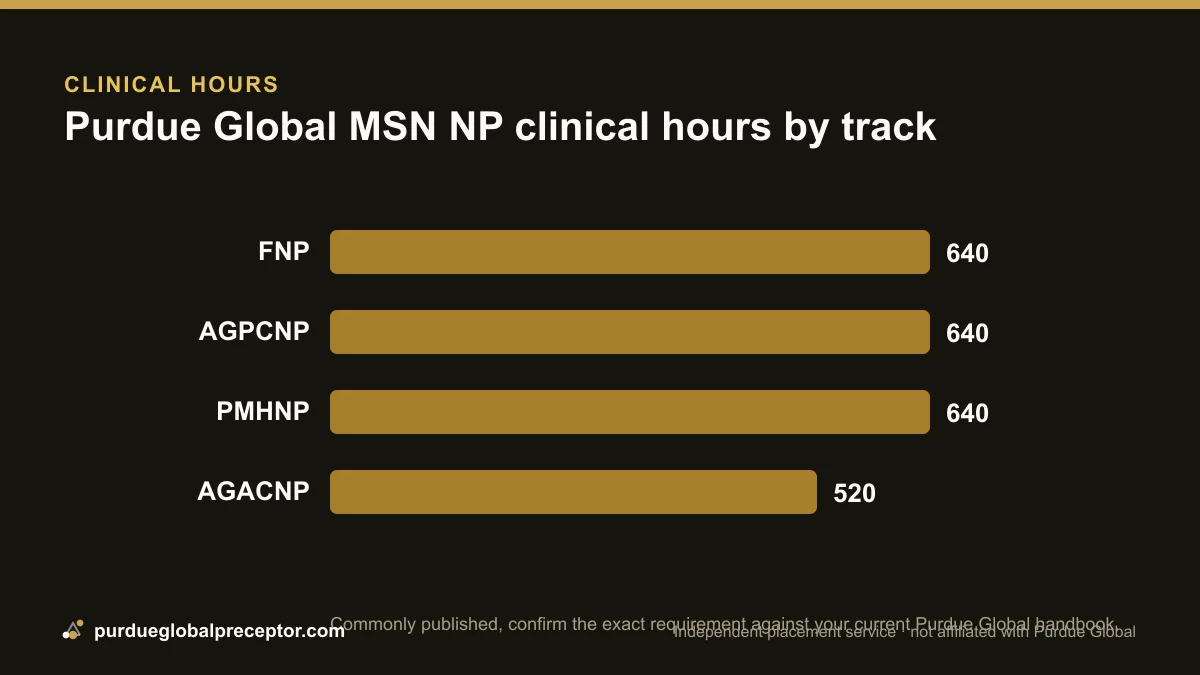
How many clinical hours each NP track requires
Every Purdue Global NP track pairs 100% online coursework with a practicum you complete in person, in your own community, with a real preceptor. The clinical hour total varies by track. The figures below are commonly published for these programs; we confirm the exact requirement against your current Purdue Global handbook before you build your plan, because program requirements can change and your specific catalog year governs.
- Family Nurse Practitioner (FNP), 640 clinical hours
- Adult-Gerontology Primary Care NP (AGPCNP), 640 clinical hours
- Psychiatric Mental Health NP (PMHNP), 640 clinical hours
- Adult-Gerontology Acute Care NP (AGACNP), 520 clinical hours
Post-master's certificates exist in these same four tracks, and they carry their own clinical hour expectations tied to the track and to credit you may already hold from a prior NP program. Treat the numbers above as the planning baseline for the full MSN, and treat your handbook as the final word. If you are weighing tracks, see the dedicated pages for the FNP, AGPCNP, PMHNP, and AGACNP practicum.
Why the totals differ between tracks
The hour gaps above are not arbitrary. They reflect what each role has to be ready to do on day one. The primary-care tracks, FNP, AGPCNP, and PMHNP, commonly land at the same 640 because each has to build broad longitudinal competence across a wide patient panel, managing chronic conditions over time and seeing the same patients across multiple visits.
The acute-care track commonly publishes a lower 520 because its scope is narrower and more concentrated: episodic, higher-acuity management in hospital and acute settings rather than the full breadth of community primary care. A smaller required total is not a shortcut. The hours an AGACNP does are denser and more specialized, which is exactly why preceptor and site approval is so specific for that track.
Either way, the number on the page is a floor, not a target to coast to. Programs and certifying bodies treat these as minimums, and a disallowed block of hours can push you below the line late in a term. That is why the rest of this guide is about protecting the hours, not just hitting the count.
Quarter credits, and why the hour number is what matters
Purdue Global runs on a quarter-credit system rather than semester credits, so the unit counts on your transcript will look different from a semester school. For clinical planning, do not get distracted by the credit conversion. The clinical practicum courses translate into the hour totals above, and it is the hours, not the credits, that the program tracks toward your completion and that state boards and the certifying bodies care about. Build your timeline around hours and let the credits follow.
Coursework being fully online does not shorten the practicum. The in-person hours are a fixed obligation regardless of how the academic side is delivered, which is exactly why the placement has to be lined up early.
What actually counts as a clinical hour
An hour only counts when four things are true at the same time. Miss any one and the time you spent may not apply toward your total, even though you were doing real clinical work. This is the part students underestimate most.
- Direct, supervised patient care. Hours are earned providing hands-on care under a qualified preceptor, not from shadowing alone, charting on your own, or commute and prep time. What qualifies as direct care is defined by your program.
- An approved clinical site. The location has to be one your program has reviewed and signed off on for your track and patient population.
- An approved preceptor. Your preceptor must meet the program's credential and experience requirements and be approved for your specialty before hours begin.
- The agreement and compliance are already in place. The clinical affiliation agreement between the site and Purdue Global must be fully executed, and your own background check and immunization clearance must be complete, before your first patient encounter.
That last point is the one that quietly erases hours. If you start seeing patients before the affiliation agreement is signed, or before your compliance clearances are done, those hours can be disallowed. Getting the order right protects everything that comes after.
How hours get logged
You record your hours in your program's clinical tracking system as you go. Expect to log each encounter with the date, the site, your preceptor, the hours worked, and often patient details such as age range, presenting problem, and the procedures or decisions you were involved in. Many programs also require your preceptor to verify or sign off on entries, and faculty review them.
Log in real time, not from memory at the end of a rotation. Reconstructed logs are error-prone, and a gap or a mismatch between your hours and your preceptor's verification can hold up a term. Keeping your own running tally alongside the official system gives you a clean record to reconcile against if anything looks off.
Watch the difference between hours and patient-encounter counts. Some programs ask you to demonstrate not just a total number of hours but a spread of encounter types, age ranges, visit categories, or specific clinical experiences. You can hit your hour total and still be short on a required category if you do not track both, so review the encounter expectations for your track at the start of the rotation, not the end.
We do not name a specific tracking platform here because Purdue Global does not publicly disclose one. Your Clinical Student Manager will point you to the exact system your cohort uses.
Planning so you do not lose hours
Purdue Global asks the student to be the lead advocate for finding their own clinical sites and preceptors, supported by the University and a Clinical Student Manager. That is real responsibility, and it is where time gets lost when students wait. We do that advocacy with you: we source the preceptor and move the paperwork so your hours start on schedule.
The single biggest variable is the clinical affiliation agreement, and how long it takes depends heavily on whether the site already holds one with Purdue Global. The timing ranges and what the agreement actually covers are laid out in full on the clinical affiliation agreement page, read that before you fix a start date, because it is usually the first domino that has to fall.
- Start a full term ahead. Begin lining up sites and preceptors well before your practicum quarter opens, not when it does.
- Favor sites that already have an agreement. An existing agreement is the fastest path to your first counted hour.
- Run compliance in parallel. Get your background check and immunization clearance moving while the agreement is in progress so neither one becomes the holdup.
- Confirm preceptor approval early. Make sure your preceptor meets your track's requirements before you commit, so hours are not retroactively questioned.
- Spread hours realistically. Map your total against the weeks in your practicum so you are not chasing a backlog at the end.
It helps to do the arithmetic before the term starts. If your track requires 640 hours and your practicum runs roughly 15 weeks, you are looking at a little over 40 hours a week of counted clinical time, which usually means full clinical days on a fixed schedule with your preceptor. A 520-hour track over the same window is closer to 35. Know that weekly number going in, because a preceptor who can only offer one day a week will not get you to the total inside a single term no matter how willing they are.
If you want help getting from zero to a signed, compliant placement, that is exactly what we do. See how our placement process works, or tell us your track and start date through finding a preceptor so we can begin lining up your hours. To turn your hour target into calendar dates, work through the practicum timeline.
Purdue Global NP clinical hours by track
| Track or program | Hours (commonly published) | Population focus |
|---|---|---|
| MSN, FNP | 640 | Family, primary care across the lifespan |
| MSN, AGPCNP | 640 | Adult-gerontology primary care |
| MSN, PMHNP | 640 | Psychiatric, mental health across the lifespan |
| MSN, AGACNP | 520 | Adult-gerontology acute care |
| Online DNP | 1,000 postbaccalaureate | Practice doctorate, CCNE accredited |
Sources: Purdue Global Catalog, MSN NP tracks · Purdue Global Catalog, DNP (1,000 hours) · AACN, DNP Essentials · NONPF, NP Role Core Competencies
Good to know
How many clinical hours does the Purdue Global FNP track require?
640 clinical hours are commonly published for the FNP track. We confirm the exact requirement against your current Purdue Global handbook, since your catalog year governs and requirements can change.
Which Purdue Global NP track has the fewest clinical hours?
Among the four tracks, AGACNP (Adult-Gerontology Acute Care) commonly publishes 520 hours, while FNP, AGPCNP, and PMHNP commonly publish 640. Always confirm the figure for your track in your handbook.
Do shadowing or charting hours count toward my total?
Generally no. Hours count when you are providing direct, supervised patient care under an approved preceptor at an approved site, with the affiliation agreement and your compliance clearances already in place. Your program defines what qualifies as direct care.
Can I start logging hours before the affiliation agreement is signed?
You should not. Hours worked before the clinical affiliation agreement is fully executed, and before your background check and immunization clearance are complete, can be disallowed even if the clinical work was real. Sequence matters.
How do I log my Purdue Global clinical hours?
You record them in your program's clinical tracking system, usually with the date, site, preceptor, hours, and encounter details, often with preceptor verification. Purdue Global does not publicly name a platform, so your Clinical Student Manager will direct you to the exact system your cohort uses.
How many hours a week does that work out to?
It depends on your track and how many weeks your practicum runs. A 640-hour track over about 15 weeks is a little over 40 counted hours a week; a 520-hour track is closer to 35. Confirm your own track's total and term length, then plan a preceptor schedule that can realistically hit that weekly number.
Get matched with a
Purdue Global preceptor
Tell us your track, your city, and your term. We'll come back with a placement plan and a realistic date your affiliation agreement can clear by.