How our Purdue Global preceptor matching works
Finding a clinical preceptor on your own is the part of the MSN that derails timelines. Purdue Global asks you to be the lead advocate for your own placement, supported by the University and your Clinical Student Manager. We do that advocacy with you: we source a qualified local preceptor and open the affiliation agreement early enough that paperwork is not the thing standing between you and your start date. Here is exactly how the three steps work, what we handle, and where your CSM fits in.
Last updated July 2026. Verified against the current Purdue Global nursing handbook.
Get matched, free
Tell us your track and city, we'll plan your placement. No payment until you're matched.
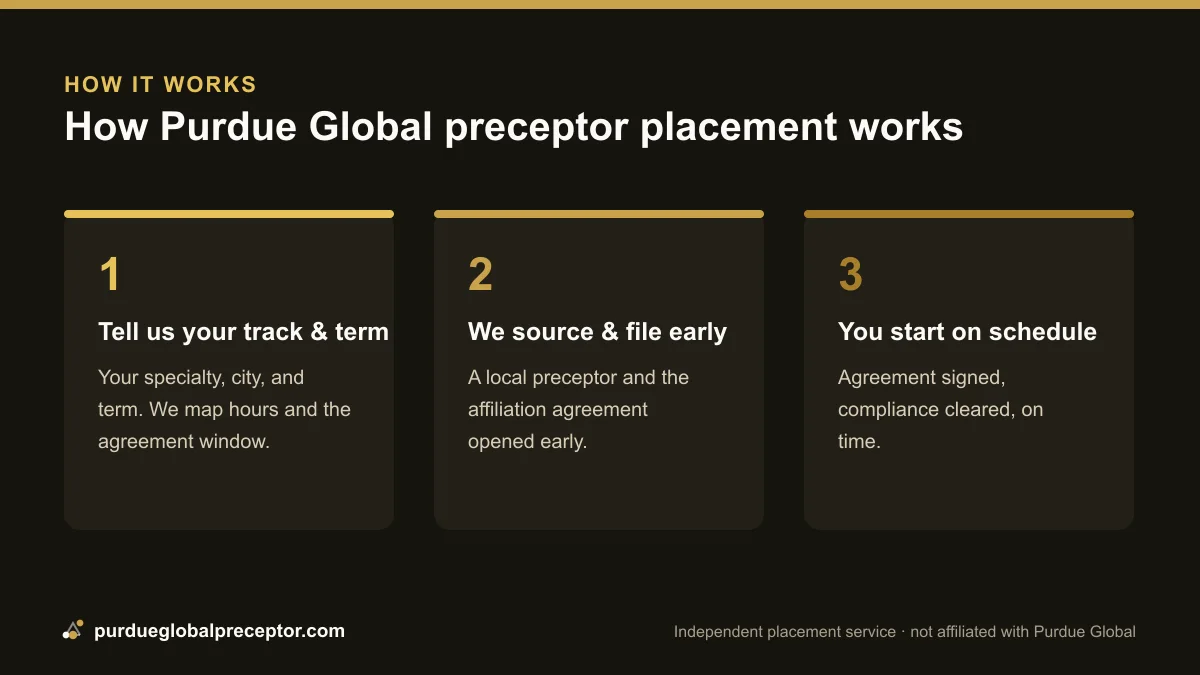
Step 1: Tell us your track, city, and term
Everything starts with three pieces of information. Which NP track you are in, where you can physically drive to clinical, and which term your practicum is scheduled to begin. With those, we can do the planning that makes the rest of the process predictable.
First we map your clinical hours so you know the size of the commitment before you commit to a site. The number depends on your track:
- FNP, Family Nurse Practitioner: 640 hours
- AGPCNP, Adult-Gerontology Primary Care: 640 hours
- PMHNP, Psychiatric Mental Health: 640 hours
- AGACNP, Adult-Gerontology Acute Care: 520 hours
Those figures are commonly published for this program; we confirm the exact requirement against your current Purdue Global handbook, because requirements can change between catalog years and your CSM is the authority on what your specific plan of study says. We would rather plan against your real number than a number from the internet.
Then we map the window the affiliation agreement has to clear in. This is the step most students do not see coming, and it is the one that decides whether you start on time. Working backward from your term start date, we identify how many weeks we have to get a site under contract with Purdue Global and a preceptor confirmed. That window, not the hours, is usually the tightest constraint, which is why we begin it the moment you reach out. See clinical hours by track for a fuller breakdown.
Step 2: We source a local preceptor and open the agreement early
With the map in hand, we go find a qualified preceptor near you in your specialty. We look for the right clinical setting for your track, a preceptor whose credentials and patient population fit your learning objectives, and a site that can host you for the hours and weeks your term requires. You can read more about what we look for in finding a preceptor.
At the same time, we open the clinical affiliation agreement, the contract between the clinical site and Purdue Global, because it is the real bottleneck in most placements and its turnaround depends heavily on whether the site already holds an active agreement, the full timeline ranges are covered on the affiliation agreement guide.
What matters for the process is the sequencing. We run the sourcing and the agreement as two parallel tracks from day one rather than one after the other, so neither sits idle waiting on the other. Where your timeline is tight, we steer toward sites that already carry an active agreement so the slowest variable is already behind us; where a brand-new site is the right clinical fit, we open the contract far enough ahead that legal review, insurance language, and the signatures on both sides finish before your term does. We also keep the document moving, following up with site administrators and the University rather than letting it sit in someone's queue, so it is never you chasing a signature. That single decision, parallel tracks started early and actively pushed, is what turns the agreement from a deadline risk into a step we plan around.
Step 3: Compliance cleared, you start on schedule
Before your first clinical day, the site will expect you to be cleared. That generally means a background check and immunization clearance, plus any site-specific onboarding the practice requires. We tell you what your placement needs, when each item is due, and how it connects to your term start, so nothing surfaces at the last minute. Full detail lives on the clinical compliance page.
You will log your hours in your program's clinical tracking system as you complete them; that is between you and Purdue Global, and we make sure your confirmed site and preceptor information is ready for you to enter. Once the agreement is executed, the preceptor is confirmed, and compliance is cleared, you start on the schedule you planned for in Step 1. That is the whole point of starting early: the start date stops being a question mark.
What we handle versus what your CSM does
Purdue Global gives you a Clinical Student Manager, and we work with the CSM, not around them. The CSM is your point of contact inside the University. They confirm your program requirements, approve placements against Purdue Global policy, and own everything on the University side of the agreement. They are the authority on what counts toward your degree.
Our job is the legwork the University asks you to lead but that is hard to do alone while you are in coursework.
- We do: source a qualified local preceptor in your track, approach sites, open and actively move the affiliation agreement, keep your compliance checklist on a timeline, and keep you informed at every step.
- Your CSM does: confirm your exact hour and course requirements, approve the site and preceptor against Purdue Global policy, and sign off on the University side of the paperwork.
- You do: stay the lead advocate of record, make the final call on a site you are comfortable with, and complete your own background check and immunization items.
Because the University frames you as the advocate for your own placement, having us source the preceptor and drive the paperwork does not replace that role, it makes it manageable. Your CSM still approves; we just hand them a placement that is ready to approve. In practice the handoff is clean because we share the site, the preceptor's credentials, and the agreement status with your CSM as we go, so when they review it there are no surprises to slow the approval down. If you want to see the full picture before you start, the preceptor FAQ answers the questions students ask most.
The three steps, and what each depends on
| Step | What we do | What gates it |
|---|---|---|
| 1. Map track, city, term | Confirm hours (FNP, AGPCNP, PMHNP 640; AGACNP 520) and the agreement window | Your handbook confirms the exact number |
| 2. Source and file early | Source a local preceptor and open the affiliation agreement in parallel | Existing site 2 to 4 weeks, new site 1 to 2 months |
| 3. Clear compliance, start | Background check, immunizations, and hours logged in the tracking system | Every item cleared before day one |
Sources: Purdue Global, Tips to Find a Clinical Placement · Purdue Global Catalog, MSN NP tracks · Purdue Global, Online Nursing Programs (accreditation)
Good to know
Are you affiliated with Purdue Global or Purdue University?
No. We are an independent clinical-placement service. We are not Purdue University, Purdue Global, or the CCNE, and we have no endorsement from them. We help you find a preceptor and clear the affiliation agreement so you can complete the practicum your program requires.
How long does the whole process take?
It depends almost entirely on the affiliation agreement, and how long that takes hinges on whether the site already holds an agreement with Purdue Global or has to negotiate a new one. The affiliation agreement guide breaks down the timeline ranges in detail. Sourcing the preceptor and clearing compliance happen alongside that, which is why we start as early as you let us.
Does this replace my Clinical Student Manager?
No. Your CSM is your University contact and the authority on your requirements and approvals. We work with the CSM, handling the sourcing and the paperwork so you can hand them a placement that is ready to approve. You remain the lead advocate of record, which is the role Purdue Global asks you to hold.
How many clinical hours will I need?
It depends on your track: 640 hours is commonly published for FNP, AGPCNP, and PMHNP, and 520 for AGACNP. These figures are commonly published for this program; we confirm the exact requirement against your current Purdue Global handbook before we plan your placement.
Can you guarantee I will start on time?
We cannot guarantee a timeline, because the agreement and approvals involve the site and the University. What we can do is start early, prioritize sites with existing agreements when your window is tight, and actively move the paperwork so the start date you planned for stays realistic. The earlier you reach out, the more room we have to work.
Get matched with a
Purdue Global preceptor
Tell us your track, your city, and your term. We'll come back with a placement plan and a realistic date your affiliation agreement can clear by.