Find an FNP Preceptor Near You
If you are in the family nurse practitioner track at Purdue Global, the search for a local preceptor is usually the hardest part of the practicum. Your coursework is online, but your clinical hours (commonly published as 640 for this program; we confirm the exact requirement against your current Purdue Global handbook) happen in person, near where you live. This page is about the local search itself: how to identify FNP preceptors in your area, what to ask before you commit, the red flags worth walking away from, and how geography and licensure shape who can sign your hours. For the program walkthrough and the full list of FNP clinical settings, see our FNP preceptor page.
Last updated July 2026. Verified against the current Purdue Global nursing handbook.
Get matched, free
Tell us your track and city, we'll plan your placement. No payment until you're matched.
How to identify FNP preceptors in your area
A qualified FNP preceptor is usually a board-certified NP, and in many cases a physician (MD or DO) or PA in a primary-care setting can supervise and sign your hours. The challenge is rarely that no one exists nearby, it is finding the clinician who is both eligible and willing, then reaching them before someone else's student does. The settings where these clinicians practice are covered on our FNP preceptor page; here the focus is on how you actually surface names near you.
Practical ways to build a local list, in rough order of how reliable they are:
- State board of nursing license lookup. Most boards publish a searchable registry. You can confirm a clinician is an actively licensed NP in your state before you ever reach out, the single fastest way to filter a name in or out.
- Your own care network. Your personal primary-care provider, a clinic you have worked at, or a former preceptor of a classmate are warm introductions that skip the cold open.
- Local clinic and health-system directories. Family-medicine groups, community clinics, and urgent-care chains list their providers online; cross-reference the names against the board registry.
- Workplace colleagues. If you are an RN, the NPs and physicians you already work alongside know who precepts and who does not.
- Professional chapters and alumni. State NP associations and Purdue Global alumni groups can point you toward clinicians who have precepted students before.
Because Purdue Global asks the student to be the lead advocate for identifying their own sites and preceptors, this list-building work falls to you, but it is exactly the legwork we take on with you, so you stay focused on coursework instead of cold-calling clinics.
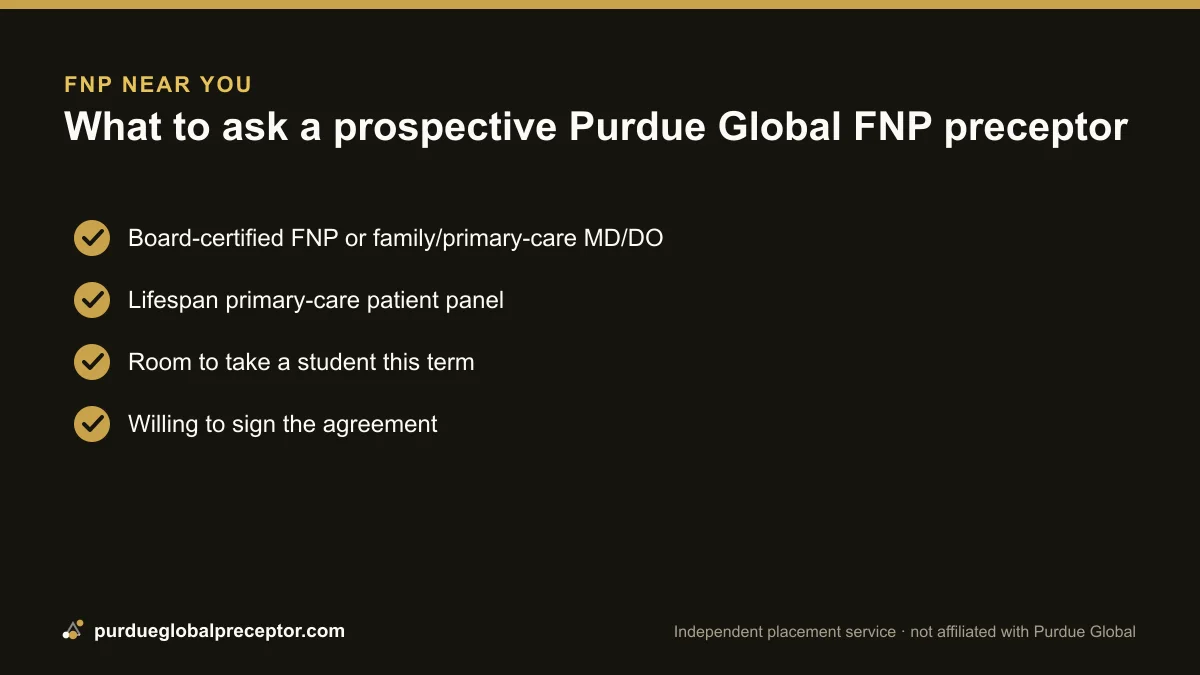
What to ask before you commit to a preceptor
A local clinician who looks perfect on day one can still stall your term if the basics are not in place. Ask these questions early, before you count on the site:
- Will you sign my hours and complete my evaluations? Some clinicians let you shadow but will not formally precept. Confirm the commitment, not just the welcome.
- Does your site already hold a clinical affiliation agreement with Purdue Global, or are you open to signing one? This is the single biggest timeline factor.
- What is your patient mix? For FNP you need patients across the lifespan; a clinician who only sees one age band may not cover the competencies your program tracks.
- How many hours can you realistically offer per week? A full FNP hour requirement is hard to finish if you only get one half-day a week.
- Will I see patients, or only observe? Your program expects hands-on, supervised practice, not a shadowing role.
- Do you precept other students at the same time? Overlapping students can dilute your patient time and your preceptor's attention.
Also confirm the practical clearances: your background check and immunization clearance, plus any site-specific onboarding, need to be done before your first day. Log everything in your program's clinical tracking system as you go.
Red flags worth walking away from
Not every yes is a good yes. A placement that goes sideways mid-term costs you more than the weeks you waited to start it. Treat these as warning signs and keep a backup option alive until the paperwork is signed:
- Vague answers about signing hours or evaluations. If a clinician will not commit clearly to the documentation, assume it will not happen.
- "Just come shadow and we'll figure it out." An informal arrangement with no agreement and no defined role rarely satisfies program requirements.
- A patient mix that does not match your competencies. A great clinician in the wrong setting still leaves gaps you cannot close before graduation.
- Reluctance to sign an affiliation agreement. A site that balks at the contract is a site that may never clear it in time.
- Too many overlapping students. If you would be one of several, your supervised patient time may be too thin to finish hours on schedule.
- An unverifiable or out-of-state license. If you cannot confirm an active license in the state where you will practice, do not build your term around that person.
When something feels off, it usually is. The cost of finding a second option early is small; the cost of discovering the problem in week six is your timeline.
Geography and licensure: who can sign your hours
Where you can rotate is bounded by licensure, not just commuting distance. Your preceptor generally must hold an active, unrestricted license to practice in the state where the clinical site sits, and that is the state where you will physically see patients, regardless of where Purdue Global is based or where you live if you are near a border.
A few specifics worth checking before you settle on an area:
- Practice authority varies by state. Some states grant NPs full practice authority; others require a collaborating physician. This shapes who is available to precept and how their practice is structured, though it does not change your hour requirement.
- State lines matter more than mileage. A site twenty minutes away across a state border may sit under a different board and a different agreement, which can complicate or slow placement.
- Confirm the license in the site's state. Use that state's board lookup, not your home state's, to verify your prospective preceptor.
- Rural and underserved areas are often the easiest yes. Practices in less-served regions are frequently the most willing to precept, which can widen your realistic search radius.
Your clinical hours are completed in person at a local site even though your coursework is 100% online, so this geography work is unavoidable, and it is most of what makes the search hard. Mapping eligible, willing clinicians within a workable commute is the core of what we do with you.
How we secure an FNP preceptor for you locally
You should not have to cold-call clinics between assignments. Here is how we find and lock in a preceptor near you:
- We map your area. You tell us your city or ZIP and your schedule, and we identify primary-care practices and clinicians within a workable commute.
- We source and confirm the preceptor. We approach FNP-appropriate clinicians, verify licensure in the site's state, confirm they will sign hours and complete evaluations, and check their patient mix against your competency needs.
- We move the paperwork. We handle the clinical affiliation agreement between the site and Purdue Global and coordinate with your Clinical Student Manager so the contract clears on time.
- We keep you ready. We help you stay ahead on background check and immunization clearance and on logging into your program's clinical tracking system, so nothing administrative delays your start.
The affiliation agreement, not finding a willing clinician, is usually what sets your timeline, which is why we tell every student to start a term ahead; see how clinical affiliation agreements work for the ranges and detail. We are an independent clinical-placement service. We are not Purdue University, Purdue Global, or the CCNE, and we do not speak for them. What we do is the legwork the University asks you to lead, done with you, near you. When you are ready, start your placement or message us and tell us where you need to be.
FNP preceptor checklist
| What to confirm | Why it matters |
|---|---|
| Active, unencumbered license in the site's state | Hours only count under a valid license in the state where you train |
| Board-certified FNP, or a family or primary-care physician (MD or DO) | Scope has to cover primary care across the lifespan |
| Patient mix from pediatrics through older adults | A single adult-only panel may not meet the FNP competencies |
| Willing to sign hours and complete evaluations | Shadowing without formal sign-off does not count |
| Site holds or will sign a Purdue Global affiliation agreement | Existing agreement, about 2 to 4 weeks; a new site, 1 to 2 months |
Sources: NONPF, NP Role Core Competencies · AANPCB, NP Certification Exam Overview · Purdue Global, Tips to Find a Clinical Placement
Good to know
How close to home can you find an FNP preceptor?
We search around the city or ZIP you give us and aim for a workable commute. FNP placements are easier to localize than most NP tracks because family medicine and primary-care sites are common almost everywhere, including rural and underserved areas where practices are often most willing to precept. The real boundary is licensure: your preceptor must be licensed in the state where the clinical site sits.
How can I verify a prospective FNP preceptor before I reach out?
Use the nursing board license lookup for the state where the clinical site is located to confirm the clinician holds an active, unrestricted license. Cross-reference the name against the clinic or health-system directory, and confirm their patient mix and willingness to formally precept before you build your term around them.
How many clinical hours does the Purdue Global FNP track require?
It is commonly published as 640 clinical hours for this program; we confirm the exact requirement against your current Purdue Global handbook. Your hours are completed in person at a local site even though your coursework is 100% online.
Can I find a preceptor who isn't a nurse practitioner?
Often yes. A qualified FNP preceptor is usually a board-certified NP, but in many cases a physician (MD or DO) or PA in a primary-care setting can supervise and sign your hours. We confirm the clinician's eligibility, licensure in the site's state, and that their patient mix fits your competency requirements before you commit.
Do you assign the preceptor, or does Purdue Global?
Purdue Global asks you to be the lead advocate for identifying your own sites and preceptors, supported by the University and a Clinical Student Manager.
Get matched with a
Purdue Global preceptor
Tell us your track, your city, and your term. We'll come back with a placement plan and a realistic date your affiliation agreement can clear by.