FNP Preceptor Placement for Purdue Global Students
The Family Nurse Practitioner track is the broadest of the Purdue Global MSN options, and that breadth is exactly what makes the clinical placement hard to arrange alone. You need a preceptor who practices primary care across the full lifespan, in scope, at a site that will sign a clinical affiliation agreement with Purdue Global. We are an independent placement service. We are not Purdue University, Purdue Global, or the CCNE, and we make no claim of affiliation or endorsement. What we do is find the right family practice preceptor for your location and move the paperwork so your hours can start on time.
Last updated July 2026. Verified against the current Purdue Global nursing handbook.
Get matched, free
Tell us your track and city, we'll plan your placement. No payment until you're matched.
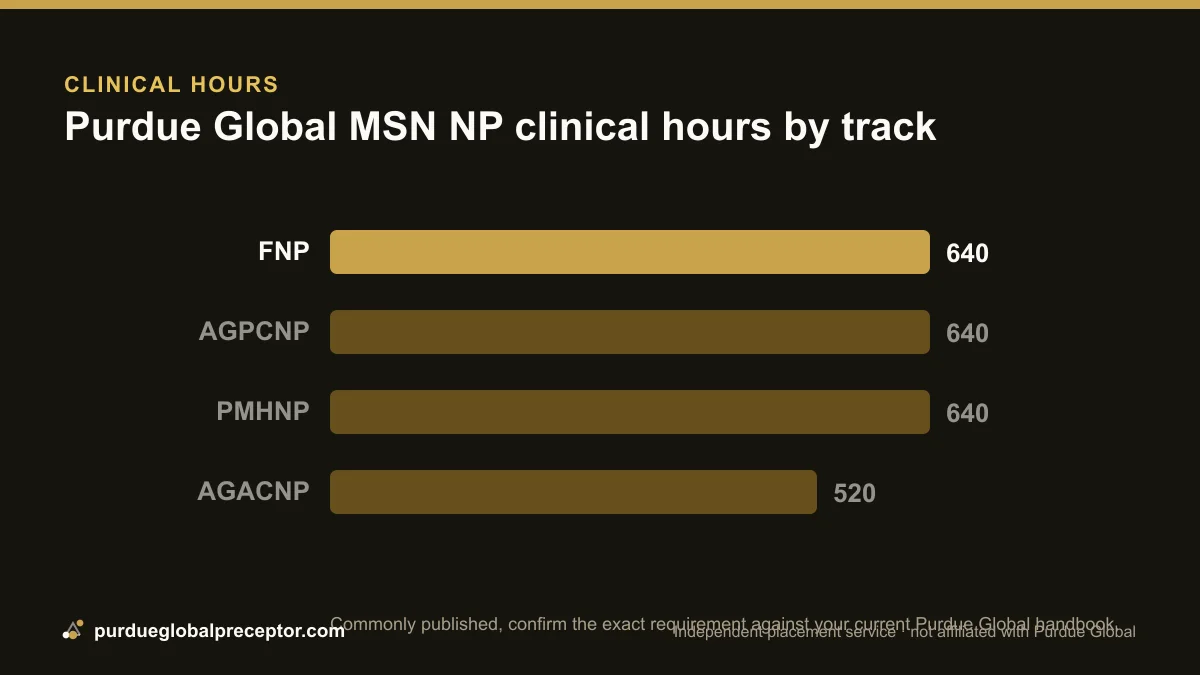
The FNP clinical requirement at Purdue Global
Purdue Global's MSN Family Nurse Practitioner track is delivered with 100 percent online coursework, followed by an in-person practicum you complete locally with a qualified preceptor. The number commonly published for this program is 640 clinical hours, but you should treat that as a planning figure rather than a fixed rule. We confirm the exact requirement against your current Purdue Global handbook before we build your placement plan, because program details change and your enrollment term is what governs.
Purdue Global uses a quarter-credit system, and the program is accredited at two levels: the Higher Learning Commission (HLC) accredits the institution, and the Commission on Collegiate Nursing Education (CCNE) accredits the nursing program. That accreditation is part of why the affiliation agreement matters so much. A site cannot simply agree to host you informally. There has to be a signed agreement on file between the clinical site and Purdue Global, and your hours only count when that agreement and your preceptor are both in place.
Under Purdue Global's model the student is expected to drive the search for their own sites and preceptors, with the University and a Clinical Student Manager (CSM) playing a supporting role. For an FNP that self-led search is unusually demanding, because a single primary-care provider rarely covers the entire lifespan on their own and you may be coordinating with more than one practice at once, all while still carrying coursework. What we do is take that legwork on with you: we source family practice preceptors whose scope fits, approach them on your behalf, and carry the agreement through to signature so you are not negotiating paperwork in your spare hours.
What counts as a qualified FNP preceptor
FNP is a primary-care, lifespan role, so your preceptor must practice in that scope. The clinical setting has to let you see patients across the age range the certification covers, not a narrow slice of it.
A preceptor for the Purdue Global FNP track generally needs to be one of the following:
- A board-certified Family Nurse Practitioner (FNP-C or FNP-BC) practicing in primary care.
- A physician (MD or DO) in family medicine or primary care, working within the scope a family practice rotation requires.
- In some cases another primary-care provider whose scope and patient population match the lifespan focus, subject to your program's approval.
The common thread is scope. An FNP rotation has to expose you to primary care across the lifespan, so a preceptor whose entire panel is, for example, adults only or one narrow specialty usually will not satisfy the full requirement on its own. We match you to a provider whose day-to-day practice fits the FNP competencies, and we flag in advance anything your program would need to review. Final approval of any preceptor and site always rests with Purdue Global, not with us.
Where FNP hours happen
Because family practice is lifespan care, FNP placements take place in settings that see a wide patient mix. The most common are:
- Family medicine and primary care clinics
- Community health centers and federally qualified health centers
- Pediatric and adolescent primary care
- Women's health and prenatal primary care
- Internal medicine and adult or older-adult primary care
- Urgent care and retail or convenience clinics that handle a broad range of presentations
Many FNP students complete their hours across more than one setting so that the experience covers pediatrics through older adults rather than concentrating in a single age group. When we plan your placement, we look at what a single preceptor's practice already covers and whether a second site is needed to round out the lifespan exposure. The goal is a plan that satisfies the FNP competencies without sending you chasing a string of disconnected one-off rotations. How the hours are distributed across settings is governed by your current Purdue Global handbook, which is why we confirm the requirement before planning rather than after.
Why FNP students struggle to place themselves
The FNP placement is hard for structural reasons, not because students aren't trying. A few of those reasons show up again and again.
First, the lifespan scope narrows the field. A preceptor who only sees adults can host an adult-gero student more easily than an FNP student who also needs pediatric and women's-health exposure. That makes the pool of fully suitable family practice preceptors smaller than it looks.
Second, busy clinics get asked constantly. In areas with several nursing programs, primary care offices field a steady stream of student requests, and many have simply stopped saying yes, especially to students they have no prior relationship with.
Third, and most often the real blocker, is the clinical affiliation agreement. A willing preceptor still cannot take you until their site's legal agreement with Purdue Global is signed, and whether that runs a couple of weeks or a couple of months depends entirely on whether the site already holds an agreement; we walk through both timelines on the affiliation agreement page. For FNP students this stings twice, because the broad lifespan scope can push you toward newer, smaller practices that have never hosted a Purdue Global student and therefore have no agreement on file yet.
Fourth, the lifespan requirement can turn one placement into two. When a single preceptor's panel does not reach from pediatrics through older adults, you may need a second site, which means a second willing provider and potentially a second agreement to clear. That doubles the coordination most other tracks only have to do once.
The honest fix is time. The earlier the search starts, the more room there is to absorb a slow agreement, line up a second setting if the lifespan exposure needs it, and keep your hours on schedule. None of these timelines are guarantees; they are typical ranges, and a single site can fall outside them in either direction.
How we source your preceptor and clear the agreement
We work the placement the way the University asks you to, but with you instead of leaving it on your shoulders. The process is straightforward.
- We confirm your requirement. We check the FNP hour total and any setting rules against your current Purdue Global handbook and enrollment term, so the plan is built on your actual program rather than a generic figure.
- We source the preceptor. We identify board-certified FNPs or qualifying family or primary-care physicians near you whose scope fits lifespan care, and we approach them on your behalf.
- We move the affiliation agreement. We determine whether the site already holds a Purdue Global agreement or needs a new one, then push the paperwork between the site and the University so it does not stall in someone's inbox.
- We handle the clearance details. We help line up your background check and immunization clearance and get your hours logged in your program's clinical tracking system, so nothing administrative holds up your start.
Because the affiliation agreement is the part most likely to run long. That is where we put the most pressure. Starting early and chasing the signature in parallel with everything else is what keeps a placement on schedule. We move the paperwork and source the preceptor; the program makes the final call on every site and provider.
FNP practicum and preceptor at a glance
| Practicum hours (commonly published) | 640 hours, confirmed against your current handbook |
|---|---|
| Population focus | Primary care across the lifespan, pediatrics through older adults |
| Typical settings | Family and primary care clinics, community health centers and FQHCs, pediatrics, women's health, urgent care |
| Qualifying preceptor | Board-certified FNP (FNP-C or FNP-BC), or a family or primary-care physician (MD or DO) |
| National certification | Family NP, sat through the AANPCB or ANCC examination |
| Accreditation | Institution accredited by HLC, nursing program accredited by CCNE |
Sources: Purdue Global Catalog, MSN NP tracks · AANPCB, NP Certification Exam Overview · NONPF, NP Role Core Competencies · Purdue Global, Online Nursing Programs (accreditation)
Good to know
How many clinical hours does the Purdue Global FNP track require?
The figure commonly published for this program is 640 clinical hours. Treat that as a planning number rather than a guarantee. We confirm the exact requirement against your current Purdue Global handbook and enrollment term before we build your placement plan, because program details can change.
Who can serve as my FNP preceptor?
Generally a board-certified Family Nurse Practitioner (FNP-C or FNP-BC) in primary care, or a physician (MD or DO) in family or primary care working within the scope a family practice rotation requires. The key is that the preceptor's practice covers primary care across the lifespan so it matches the FNP competencies. We flag anything your program would need to review in advance, and Purdue Global makes the final approval.
Why does the affiliation agreement take so long?
Your FNP hours only count once there is a signed clinical affiliation agreement between the site and Purdue Global, and how long that takes depends on whether the site already holds one. Because lifespan scope often points FNP students toward newer practices with no agreement on file, it is worth starting early. We break down the typical timelines on our affiliation agreement guide.
Can my FNP hours be split across more than one site?
Often, yes. Because FNP is lifespan care from pediatrics to older adults, many students round out the required exposure across more than one setting when a single preceptor's panel doesn't cover the full age range. We look at what each preceptor's practice already includes and only add a second site when it's needed to meet the FNP competencies. The exact rules come from your current Purdue Global handbook.
Are you affiliated with Purdue Global?
No. We are an independent clinical placement service. We are not Purdue University, Purdue Global, or the CCNE, and we make no claim of affiliation or endorsement. We work alongside the student-led placement model the University uses, doing the preceptor sourcing and paperwork with you.
Get matched with a
Purdue Global preceptor
Tell us your track, your city, and your term. We'll come back with a placement plan and a realistic date your affiliation agreement can clear by.