The Clinical Affiliation Agreement, Explained for Purdue Global NP Students
A preceptor saying yes feels like the finish line. For Purdue Global nurse practitioner students, it is closer to the starting gun. Before you can log a single clinical hour at a site, that site and Purdue Global have to sign a clinical affiliation agreement: a contract between two organizations, not a handshake between two people. This is the step that quietly decides whether your practicum starts on schedule, and it is the one students learn about too late. Here is exactly what the agreement is, why it stalls placements, and how starting early keeps your start date intact.
Last updated July 2026. Verified against the current Purdue Global nursing handbook.
Get matched, free
Tell us your track and city, we'll plan your placement. No payment until you're matched.
What a clinical affiliation agreement actually is
A clinical affiliation agreement is a written contract between your clinical site (a clinic, hospital, group practice, or individual provider's practice) and Purdue Global. It sets the legal terms under which a student is allowed to train at that site. It is signed by the organizations, not by you and not by your preceptor. Your preceptor agreeing to teach you is necessary, but it does not create the legal relationship the University requires before you begin hours.
Think of it as two separate yeses. The first yes is your preceptor saying they will supervise you. The second yes is the site's administration and Purdue Global agreeing, in writing, on liability, insurance, and who is responsible for what. Your hours only count once the second yes is in place. A preceptor can be fully on board while the agreement sits unsigned for weeks, which is why a verbal commitment is reassuring but not the same as being cleared to start.
Purdue Global asks the student to be the lead advocate in identifying clinical sites and preceptors, supported by the University and a Clinical Student Manager (CSM). That means the responsibility to surface a willing site lands on you. The affiliation agreement is the formal step that turns your found site into an approved one. We do that advocacy with you: we source the preceptor and move the paperwork so the agreement does not become the thing that derails your term.
Why a preceptor's yes is not enough
Students routinely assume that once a provider agrees to precept, placement is settled. In practice, a willing preceptor at a site with no agreement is a willing preceptor you cannot legally train under yet. Until the affiliation agreement is executed, the site has no authorized relationship with Purdue Global, and your program cannot approve hours logged there.
Two things have to be true at the same time before you start: a qualified preceptor has committed to supervise you, and the site has a signed affiliation agreement with Purdue Global covering your rotation. Miss either one and the rotation does not begin. The agreement is the piece most likely to be missing, because it depends on the site's leadership and legal review rather than on the clinician who said yes.
This is also why the right early question to ask any prospective site is not only whether a provider will precept, but whether the site already holds an agreement with Purdue Global. The answer changes your timeline dramatically, as the next section shows.
The timeline: existing agreement vs brand-new site
The single biggest factor in how long this takes is whether the site has done it before.
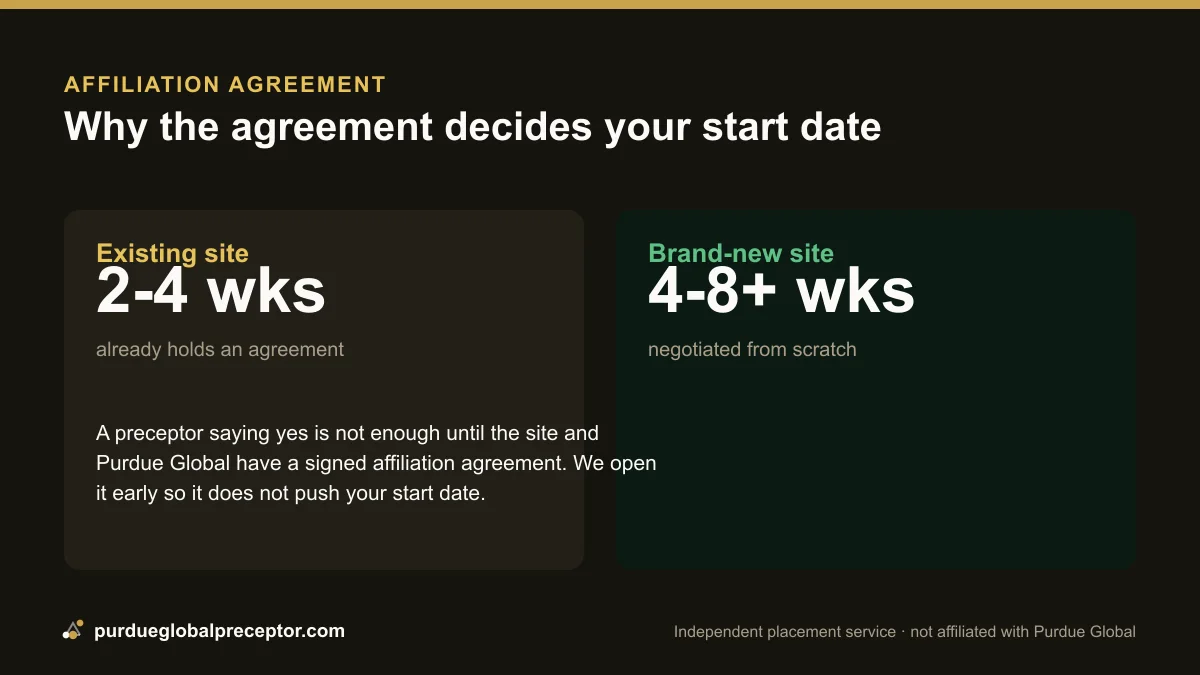
- Site already holds an agreement with Purdue Global: roughly 2 to 4 weeks to confirm and apply it to your rotation. The legal terms are already negotiated; the work is largely administrative.
- Brand-new site with no existing agreement: commonly 1 to 2 months or longer. A new site has to review the contract, route it through its own administration or legal counsel, and negotiate any terms it wants changed before signing.
These are typical ranges, not promises. A new site can move faster if its leadership is responsive, and it can take longer if the contract sits in a busy administrator's queue or if legal asks for revisions. We will not guarantee a date we cannot control, and you should be skeptical of anyone who does. What we can do is give the process a head start and keep it from going quiet.
The practical takeaway: a site that has trained Purdue Global students before is the lowest-friction option. When the only available site is new to the University, treat the agreement as a one-to-two-month task that should be opened the moment the site shows interest, not after everything else is arranged.
What the agreement covers
The contract exists to protect both organizations and to make responsibilities explicit before a student ever walks in. While exact language varies, an affiliation agreement generally addresses:
- Liability and indemnification: which party is responsible if something goes wrong during the rotation.
- Insurance: the professional liability coverage required of the student, the school, and the site, and proof that it is in force.
- Each party's responsibilities: what the site provides (supervision, a clinical environment), what the University provides (a prepared student, oversight), and what the student must do.
- Student requirements: the clearances you must complete before starting, such as background check and immunization clearance, and adherence to the site's policies.
- Supervision and evaluation: the preceptor's role in supervising and assessing your performance.
- Term, renewal, and termination: how long the agreement lasts and how either party can end it.
Because these terms touch insurance and legal exposure, a new site cannot simply sign on the spot. Someone with authority has to read it, and that review is where the calendar time goes. None of this is unusual or a sign of a problem; it is the normal cost of doing clinical education correctly, and it is entirely predictable once you know to plan for it.
Why the agreement stalls placements
The agreement stalls placements for a simple reason: it is the one step that depends on people who are not focused on your graduation date. Your preceptor cares about you. The administrator who has to sign the contract is balancing it against a hundred other tasks. When the document lands in that queue late, it waits.
Common stall points are easy to name. The contract reaches the wrong contact at the site and goes nowhere. The site's legal reviewer wants a term changed, and the redline has to travel back to Purdue Global. The site has never precepted for the University and is cautious about signing anything new. Each of these adds days or weeks, and each compounds if you only discover the agreement is needed close to your intended start date.
The failure pattern is almost always the same: the student lines up a preceptor, assumes placement is done, and finds out only weeks later that the agreement was never started. By then the start date is at risk. The agreement did not stall because it is hard; it stalled because it started late.
How starting early fixes it, and how we open and track it
Time is the only real lever here, and it is one you control. If a brand-new site needs one to two months, then opening the agreement two to three months before your term gives that timeline room to breathe. Starting early does not make a site sign faster; it means the normal length of the process finishes before your start date instead of after it.
Here is how we handle the agreement with you:
- Confirm status first: we check whether your target site already holds an agreement with Purdue Global, which tells us immediately whether we are on the 2-to-4-week or the 1-to-2-month path.
- Open it through the right channel: we help get the agreement to the person at the site who can actually authorize it, so it does not stall on the wrong desk.
- Move the paperwork: we coordinate the document exchange between the site and Purdue Global and help shepherd any revisions the site's reviewer requests.
- Track it and follow up: we keep the agreement from going silent, checking in on its status so a quiet inbox does not become a missed start date.
- Run your clearances in parallel: while the agreement is in motion, you complete your background check and immunization clearance through your program's clinical tracking system so nothing waits on anything else.
We are an independent clinical-placement service. We are not Purdue University, Purdue Global, or the CCNE, and we do not speak for them; we work alongside you and your Clinical Student Manager to get a willing site, a signed agreement, and a confirmed start. The exact requirements for your track, including your total clinical hours, are the ones in your current Purdue Global handbook, and we confirm them against it rather than assume. If you want to see how the agreement fits into the larger placement process, read how it works, and when you are ready to begin, you can find a preceptor with us. For a month by month version of that head start, see the practicum timeline.
Affiliation-agreement timeline by site type
| Site situation | Typical timeline | Why |
|---|---|---|
| Site already holds a Purdue Global agreement | About 2 to 4 weeks | Legal terms are already negotiated, so the work is largely administrative |
| Brand-new site with no agreement | Commonly 1 to 2 months or longer | The contract must be reviewed by the site's administration or legal counsel before signing |
Sources: Purdue Global, Tips to Find a Clinical Placement · Purdue Global, Online Nursing Programs (accreditation)
Good to know
Is a clinical affiliation agreement the same as my preceptor agreeing to teach me?
No. Your preceptor's commitment is a personal yes to supervise you. The affiliation agreement is a separate contract between the clinical site and Purdue Global covering liability, insurance, and responsibilities. You cannot log hours until both are in place, and the agreement is the piece most often missing.
How long does a clinical affiliation agreement take?
If the site already holds an agreement with Purdue Global, confirming it typically takes about 2 to 4 weeks. A brand-new site that must negotiate one from scratch commonly takes 1 to 2 months or longer because its administration or legal counsel has to review and sign. These are typical ranges, not guaranteed dates.
Why does the agreement take so long at a new site?
A new agreement touches insurance and legal liability, so someone with authority at the site has to read it, and they may want terms changed before signing. That review competes with everything else on their desk. The delay is normal; the fix is opening it early so the review finishes before your start date.
What can I do to keep the agreement from delaying my start?
Start early and ask each prospective site whether it already holds an agreement with Purdue Global. Open a new agreement two to three months ahead, get it to the right authorizer, and complete your background check and immunization clearance in parallel so nothing waits on anything else. We help open and track the agreement with you.
Are you affiliated with Purdue Global?
No. We are an independent clinical-placement service. We are not Purdue University, Purdue Global, or the CCNE, and we do not act on their behalf. We work alongside you and your Clinical Student Manager to source a preceptor and move the affiliation-agreement paperwork.
Get matched with a
Purdue Global preceptor
Tell us your track, your city, and your term. We'll come back with a placement plan and a realistic date your affiliation agreement can clear by.